
Image
Creating Visions of Future War
Speculative Fiction as a Pedagogical Tool in Security Studies
Between April and December 2025 students at the Institute of Security and Global Affairs and the Institute for History (Leiden University), supported by a KIEM grant, conducted an educational experiment titled Creating Visions of Future War. The project explored how creative writing, when embedded within a structured analytical framework, can function as a serious pedagogical tool in security studies and strategic studies. At its core, the initiative challenges the persistent assumption that analytical rigour and imagination belong to separate domains.
Although security studies and strategic studies have long recognised uncertainty as a defining feature of war,[1] educational practice often struggles to cultivate imaginative competence in systematic ways.[2] While established foresight tools offer useful techniques, they frequently channel imagination into formats shaped by institutional routines and prioritise structured variables and projected outcomes. In contrast, speculative narratives operate through perspective and lived experience, allowing reflection on how security decisions unfold for people working and living through conflict.[3]
To do so, the project invited students to produce speculative narratives about the future of war. These narratives were not conceived as free-form creative exercises, but students were required to ground their stories in contemporary security studies debates, emerging political and technological developments, and relevant historical precedents. Creative writing then served as a means of integration, requiring students to combine research and theory with imagination. This process pushed students beyond abstract reasoning and forced engagement with uncertainty as an ongoing condition rather than a variable to be resolved.
The pedagogical design reflected this ambition, as the writing process was supported by a structured programme that combined academic supervision from scholars in history and security studies with workshops led by a professional fiction writer, focusing on narrative structure, world-building, and plausibility. This dual framework ensured that the produced works were grounded in research while prioritising imaginative exploration. As such, the project made it possible to surface assumptions that often remain implicit or unthought in formal analysis. A central aim of the project was thus to draw on student creativity to generate fresh viewpoints on security issues, with the explicit intention not to offer prediction or guidance. Instead, the narratives act as alternative lenses through which security challenges can be viewed. The resulting works demonstrated that student creativity can surface questions and tensions that do not easily emerge from professional strategy-making considerations. For security professionals, these perspectives may offer unfamiliar but useful insights.
The student work presented here is shared in that spirit. It is offered as an invitation to reflect on how future conflicts might be imagined, how strategic assumptions shape those imaginations, and how alternative perspectives might expand the space of strategic thought. In doing so, Creating Visions of Future War suggests that speculative fiction can complement existing approaches by expanding imaginative space and challenging habitual ways of thinking about future security environments.
Dr. Malte Riemann, Institute of Security and Global Affairs – Leiden University
[1] Michael Fitzsimmons, ‘The Problem of Uncertainty in Strategic Planning’, Survival 48 (4) (2006) 131-46.
[2] John B. Richardson IV, Real Leadership and the U.S. Army. Overcoming a Failure of Imagination to Conduct Adaptive Work, Letort Paper, Strategic Studies Institute, U.S. Army War College Press (2011).
[3] Hannah Partis-Jennings, ‘Refusing the robot? Narrating the humanity of the future soldier’, Media, War & Conflict, 18 (4) (2025) 498-514.
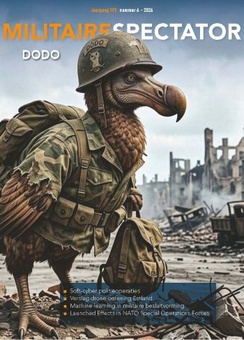
DODO
Manu Finch stared at the command post. He had been directed here by the soldier on guard, but it wasn’t much to look at. The CP was hidden in the driveway of an abandoned villa on a street full of abandoned villas. He wasn’t allowed to make pictures here, but this CP was hardly worth the effort of pressing the shutter on his camera anyway. It was just a van, after all.
Finch had written the article about it himself. Agile and enduring were a CP’s code words now. Data ran the show, and command posts were not a place, but a service. It was a magnificent fortress of quantum encryption, data security and Trojan horses that concealed and defended the CP’s electromagnetic footprint. And yet, all Finch’s camera would ever capture of it were the tracks in the sand as the expandable vans drove off to save the company’s leaders from being bombed in their agile data centers.
Finch rolled up his sleeves and dragged his eyes away. The vans weren’t what he was here for this time. He turned to the only soldiers in sight, lounging in and around two cars under the cover of the villa’s garage. The cars were dusty and dented from the impacts of small rounds, but the windows were clean, and the tyres seemed well-maintained.
One man was leaning against the hood of the first car, silently listening to the conversations around him. His eyes were hidden underneath a weathered cap, but it was clear he had spotted Finch looking at him. The man sighed and drank the last of the contents in his mug before collapsing it and stashing it away in his vest. He pushed himself upright and made his way over with long, even strides. Finch stepped forward and they met halfway.
The man was half a head taller than Finch with a short beard and shorter hair. His clothes and gear looked—well-used, and the sergeant stripes on his uniform had seen better days, but his eyes were clear and sharp. The sergeant glanced at the camera hanging around Finch’s neck and held out a calloused hand. “You the sightseer?”
“Sergeant,” Finch shook his hand, “my name is Manu Finch.”
The corner of the sergeant’s mouth lifted in half a smile at the name, but it faded again as fast as it had appeared. “So, the briefing wasn’t a joke then,” he said, “you’re press.”
“I’m a photographer,” Finch said, “and a journalist.”
The sergeant grunted. “And here I thought those were extinct. Killed off and all.”
“War photographers or journalists?”
The stones crunched underneath the sergeant’s boots as he shifted. “Either. Both. Haven’t seen any of you in a while.”
Finch glanced over the sergeant’s shoulder. At the bright blue sky. He nodded. “I’m still here.”
When he looked back at the sergeant, the man was still staring at him. Dark eyes, weary. But not unkind. The sergeant nodded too. “So are we.”
His eyes fell on the camera again and for a moment, it looked like the man wanted to sigh in dismay. But he didn’t. “Let’s keep it that way,” the sergeant said instead, and Finch appreciated the phrasing. As if that was up to any of them at all.
*
The sergeant introduced himself as Kitfox, and Finch didn’t get the chance to ask if that was a callsign or his name before the sergeant led him back to the group.
“Bravo, eyes here,” Kitfox said as he approached his group, “this is Finch. The journalist.” Finch nodded at the group. All seven soldiers were between twenty and forty. They all wore the same grey uniform, the same vests and all carried the same type of weapon. Most nodded a greeting back, and about half threw him a smile. But there was a man, sitting sideways in the driver’s seat of the first car, who drew Finch’s attention. His greying hair was unevenly cut, and it accentuated the sharp angles of his face. His grin was all teeth.
“Journalist,” the man sneered, “don’t you mean ‘warfluencer’?”
Kitfox kicked his shoe in a very tame reprimand. “We aren’t interesting enough for the phone-roaches,” he said and then turned to Finch. “Finch, this is corporal Hound, my second.”
Hound’s eyes bored into Finch’s, shining with cold curiosity. “Well, at least there are enough of those roaches,” he said slowly, “they just can’t seem to die. Unlike you truth-seeking journalists.” He tilted his head. “You’re part of a dying breed, aren’t you? More of a dodo than a finch.”
Finch’s hand tightened on his camera. He met the corporal’s piercing gaze. “Careful how you speak of my colleagues, corporal,” he said evenly, “dodos don’t sing, but I assure you that my colleagues sang louder than anyone else. And they didn’t just die out. They were killed for it.”
Hound sat back against the car seat with an amused smile. “Damn right,” he nodded, strangely satisfied. He glanced at his sergeant. “Turns out our bird has teeth, Kit. He’ll fit right in.”
*
Since Kitfox’s group had only been waiting for Finch, they left the very same hour for the city.
They’d approach by car, then enter through the tunnels and walk through what was left of the houses to their assigned position. The Special Urban Forces had found the last rebel stronghold, confirmed it was free of hostages and civilians and signaled for a missile strike. Both human and artificial reasoning predicted that the rest of the lingering fighters would abandon ship after their last safehouse was reduced to ash. They’d take the alleys, they’d take the roofs, they’d take the tunnels. And Kitfox’s group was one of the teams that would be waiting for them at the end of the road.
*
07:34 | En route: car | speech recording
Alright, thank you for agreeing to this interview. Can I ask your name and rank, please?
A ‘please’ and a ‘thank you’? How polite. You’re not the chatty sort, are you? I thought all journalists were supposed to charm people into laying bare their secrets, not ask for permission.
I’m not here for your secrets. I’m here for the city and the people targeted by Manus Dextra (MAD). Can you tell me about the situation in the city? I heard there will be an offensive against the last MAD stronghold soon.
It’s not a stronghold, it’s a fucking rat’s nest, write that down. And what is there to tell? They will all die, and the world will be better off without them. And you’re here to beat the roaches to the scoop then, did you? The first one to tell the story of how we took down those rabid dogs, huh? Do you even know this city?
Yes. I grew up here. My parents, my older brother and I lived near the river.
Ah, fuck. Have you been here since? There is not much left of it, I’ll tell you that. After the first Concussion and the bombings, those fucking animals moved in like they owned the place. Shot every building and street to pieces. We’ve been using their debris to mount our defenses out here.
I’ve seen the pictures, yes. What do you mean by Concussion?
The Concuss—you know, like a concussion rifle? Don’t you know? It’s what we call the attacks those bastard traitors paralyzed the main cities with before the invasion; prepared the battleground if you will. Ha, I want the credits if you quote that. C’mon, you know what I mean, when they blew up the unguarded electrical pylons, exploded the unprotected gas pipelines and powerhouses with fireworks, went after the water, clogged up the roads with vans, blocked the bridges, scattered the emergency services, crippled the food supply.
Right, I got it. I was there that day. I was unaware of the slang you got for it in the army.
What do you call it then? You and your editors?
Urbicide.
*
The Bravo group was waiting at the assembly area when Kitfox came to sit next to Finch. He didn’t say anything, but when he held up the thermos filled with coffee, Finch raised his own foldable cup to it. The smell of weak filter coffee filled his nose, and he breathed in slowly to savor it.
“I hope you know what you’re doing,” Kitfox said eventually, “this is an active warzone. You aren’t under any oath to be here.”
Finch smiled grimly. “I’m aware of the risks, sergeant,” he said evenly, “but I have an oath of my own.”
Kitfox looked at him. Sharp dark eyes roved over Finch’s face. “Is that oath worth your life? Those trapped rats have never needed an excuse to kill a journalist. There will be other stories that need telling after this.”
“Everyone can tell a story,” Finch replied and failed to keep the bitterness out of his tone, “I mean to tell the truth. And it will be told here.”
“And what truth is that?”
Finch sharply turned to Kitfox, but the sergeant was looking at him with an almost startling sincerity. Finch set his jaw. And looked away. “The complete one,” he said, watching the coffee cool down in his cup, “the truth I believe in speaks of everything. Everyone.”
Kitfox shook his head. “Finch,” he sighed, “you really want to hear what those bastards in the city have to say for themselves? I can tell you right now that those words are not worth hearing.”
Finch nodded somberly. “MAD is cruel beyond measure, I know. I’ve seen it. But I have always believed that every side should be able to speak. I still do. It’s what makes me a journalist.”
Kitfox looked at the city’s skyscrapers, outlined in the horizon in front of them. The tired lines around his eyes were stark in the morning light. “Why?” His voice was soft. “They killed your friends, all those reporters. As the last one, you have more reason than anyone to hate them.”
And a few years ago, Finch would have had an immediate answer at the ready. Something about the responsibility to report true and fair, to hear all sides. Something about balancing all voices and taking care not to perpetuate the bias of a one-sided narrative.
But those words tasted bitter in his mouth now, Finch asked himself every day when that had happened. He wondered what it meant that telling the worn sergeant he didn’t hate MAD was a lie, and he wondered what kind of a journalist that made him. He wondered what his colleagues, his friends, would have answered in his stead, and he wondered if their quietness felt as jarring for other people as it did for him. He wondered what it meant to be the last one left and if he should tell Kitfox about how he was less afraid of being killed than of dying. About that feeling of standing alone, with his hands stretched out, on the edge of a cliff, knowing he wouldn’t survive if he fell. About how hard he was trying to hold on to a belief that was slipping through his fingers like water, and about how, deep down, he knew it didn’t matter if he’d be killed here or some other place down the line, because the last journalist would be dead before that happened.
So why? Did he hate them? Would it matter if he did? He still wanted the truth; he still needed to understand. Because they still needed to move on after this.
“Because to speak is to be human,” Finch said at last in the silence, “because this war will end and I have to believe that the gap can still be bridged.”
Kitfox huffed. “I thought you told Hound in the car that you were there, during the Concussions. I thought you had seen it.”
Finch looked at him, confused. There was a wry laugh around Kitfox’s mouth when he looked back, and the look in his eyes was almost pitiful. “Those traitors bombed all the bridges.”
*
When the sun set, it was time to go. “Tarsier, Gecko,” Kitfox said as the team gathered at the entrance of the tunnels, “you’re up front. I’m third in line. Badger with the scrambler is the fourth. Hound’s section is after that. The tourist is between Hound and Mouse.”
Kitfox looked at Finch to see if he’d understood, and Finch nodded in confirmation. Then, when the sergeant turned around, he leaned over to the soldier standing next to him.
“That scrambler, does it really cover the entire group?” Finch asked her quietly, and the soldier nodded. “This one does.”
She saw the surprised look on his face and grinned. “Don’t think about getting one for yourself. They’re illegal for private use.”
Finch looked at her and wondered if he should tell her that, through the right channels, ordinary CCTV jammers were now widely available, even in the public domain. The military had publicly invested in stronger and more sophisticated jammers to scramble a drone-camera’s pixels from a greater distance, and as a result, the older models had found their way to the civilian market.
Finch was about to tell her he carried a small one in his backpack himself, but it was too late.
“Gecko!” Kitfox called with an impatient note in his voice. The soldier shot Finch a quick smile and then hastily made her way over to the front. Finch shrugged and while the group got ready, Finch checked all his gear as well. He had been given a helmet and a bulletproof vest. Concrete grey like a proper urban unit uniform. His camera rested on top of his vest, and the spare one was secured in the little shoulder bag. A third, smaller camera was stashed in his backpack.
Automatically, Finch’s hand fell to its familiar place on the shutter. The cameras and the thin purple band around his upper arm that could only be seen up close were the only hints of the journalist he still was. The times of PRESS vests and the word ‘TV’ spelt with tape on the back of jackets were over and he hadn’t had the time yet to mourn it on top of everything else that needed mourning.
A shadow fell over him and Finch looked up into the sharp eyes of Hound. “When we’re inside the tunnels, there can’t be any questions,” the corporal warned quietly, “we need to be silent. Not quiet. Silent. You have two minutes to ask directions on your quest for truth to my bright-eyed team before we’re leaving. That’s it.” Finch nodded. Two minutes could feel like an eternity in places like these. It would do.
*
21:16 | En route: tunnel entrance | speech recording
Thank you for letting me make use of your spare minute. Can I ask your name and rank?
Eh, yeah, it’s Mouse, and I’m just a private. No specializations.
Apart from being in the urban division of the army.
Ha, yeah, apart from that.
Did you choose to go urban, or were you selected at random?
Oh no, I didn’t really get to choose. They select the officers and sergeants based on their individual leadership qualities. That’s extra important in urban terrain. But the privates are just divided equally between fighting in the mud or on the concrete. I guess I was just above average on the obstacle course. Eh, that’s based on urban terrain after all.
They call you Mouse. Is that a nickname? Can I ask how you got it?
It’s because of all the mouseholing we have to do here. I guess I—
“—Mousey, Dodo. Time’s up!”
*
The city was unrecognizable. Finch had been told to stick close to Hound, to move when the corporal moved and to stop when he stopped, but when they turned the corner and Finch saw what was left of the street where his brother had taught him how to ride a bike, he stopped and stared.
“Finch, this is not the time,” Hound muttered and placed a hand on his shoulder. Not in a gesture of support, but in an effort to pull him along. Wordlessly, Finch shrugged the hand off his shoulder and reached for the camera. The shot took less than five seconds, but Hound’s eyes were cold and impatient by the time Finch looked back into them.
“Are you done, Dodo?” he snapped, and Finch fell back in line.
“What happened here?” he asked, but Hound just snorted. “Ask the dogs who shot everyone to hell.”
There was a careful tap on his shoulder and Finch turned around. Mouse caught his eye and gestured with his chin towards the huge crater in the street where the grey debris was still stained with dark patches of blood.
“The subway station,” he said quietly, “we used it as a transportation tunnel. But at some point, when we ran out of bomb shelters, we were forced to put civilians there as well, as a temporary solution. The enemy found out. Blew up the station. They—” Mouse hesitated, “they didn’t even give a warning.” Something tightened in Finch’s chest. Something vicious, something hateful. It was gone in a flash and Finch looked at the crater and the lives that had been lost here. In his mind, the edge of the cliff he was standing on crumbled a little further He tightened his hold on the camera.
“That’s—that’s heinous,” he breathed, “why?” The question was naïve, and yet instinctive. “Why would MAD—"
Hound scoffed and turned around. “Cause the invaders paid them to do so, obviously. And don’t call them that, Dodo. No one here calls them that.”
Finch looked at Mouse. The young man shook his head slightly, confirming his corporal’s words.
“Why not? It is their official name,” Finch said, and Hound spat on the ground.
“They’re traitors, sold their country to the invaders, kill everyone in their path, they’re dogs. They deserve death, not a name. Now, keep moving.”
In the silence that followed, Finch looked at Kitfox, who was walking with his section just ahead of them. As if he knew Finch would look at him, the sergeant met his eyes over his shoulder. But Kitfox kept quiet, and the corporal’s words hung uncorrected in the air. Finch looked at the crater in his childhood street and felt the water slip faster and faster from his fingers.
*
The traces of the army’s near-victory were everywhere. As were the signs that it was a hard- fought battle. Every single street, alley and avenue was blocked off with debris, with cars, with barbed wire. The foreign invaders had pulled back their forces months ago due to certain—personnel shortages on their side and the fact that this city didn’t hold any strategic value, per se. That had left the city in the hands of MAD.
In the beginning stages of the war, many of Finch’s colleagues had spent their time researching the group’s development from a national, extreme-right political movement to this violent organization, willing to aid the invasion of their own country. Some pointed to psychology: the presence of an existential fear, the perceived absence of a political solution. Others pointed to events that created moments of opportunity: the disbandment of the UN, the absence of information verification, the availability of weapons and mass influence via social media and gaming platforms. At least, everyone agreed that without the foreign financial support, MAD would never have grown into the brutal urban guerilla they’d become.
Finch had seen the result of their attacks with his own eyes. A bingo card of war crimes: no discrimination between combatant and non-combatant, phosphor attacks in the city, starving tactics along with targeted killings in broad daylight. All attempts at negotiations had been refused and while the invaders were regarded as the enemy, most people thought MAD as worse. Traitors, cowards, demons. There was no talking to them. There was no understanding. There were no faces behind the masks anymore. Nuance had died long before this war, but MAD had pulled it from its grave and punched its rotting face once more for good measure and then spat in black and white on its corpse. It was no longer about good and evil. This war was about humans and who deserved the title. It was about who could give it and who could take it away.
*
Finch looked at the torn-up street, and he didn’t see the small, yellow jacket discarded on the asphalt. He didn’t see the bunker where twenty women and children had waited for the four brave souls who had gone out in search of food and had never come back. He didn’t see the make-shift hospital where a veterinarian had been the only healthcare professional the people had left. He didn’t see the traces of sniper fire on the buildings, the broken homes, the craters and pockmarked walls.
Instead, Finch looked at the street and saw his brother play a ballgame with his friends, on a road with pink flowers in carefully maintained flowerpots. He could hear his young voice calling his teammates ever onwards, yelling and laughing. It echoed joyfully between the unbroken houses. His brother was very young here. Later, they only ever played football online.
Finch blinked, and the echo of his brother was gone; his youthful screams faded into silence. He closed his eyes. He knew the city would remind him of the carefree child his brother had been. But it hurt all the same. His knuckles turned white as they gripped the camera.
Standing next to him, Hound’s eyes clocked the movement immediately. But for once, the corporal’s sharp gaze averted without a word.
*
There was an actual warm dinner available. The dehydrated meals, which came to life with a little hot water, boosted Bravo’s morale significantly, especially when Finch added his own snacks to the pile for everyone to share.
The group was quietly talking amongst each other when the topic of the Robot Referendum came up.
Gecko nodded at Finch, who was sitting just outside the circle. “Where were you?” she asked curiously, “during the Referendum?”
It wasn’t a time Finch liked to be reminded of. “South,” he said.
Next to Gecko, Hound’s grin was wolfish. “Make yourself useful there, did you, Dodo?”
“I managed to vote, if that is what you’re asking.”
Hound leaned forward, his grin widening. It never reached his eyes. “And? Did you support the robots that longed to boost our numbers and help us fight the battle to secure our right of existence?” The cynicism dripped from his voice.
“Hound,” Kitfox sighed from the side, “back off.”
Finch looked at the corporal. There was a righteous anger burning in Hound’s eyes. On the cliff, the wind was howling like a pack of wild dogs.
“No,” Finch answered Hound steadily, “I voted against autonomous weapons in the field.”
Hound’s eyes flashed in satisfaction, and he sat back against the stone. “Why?” he demanded.
Finch rubbed his thumb over the shutter of his camera and thought of the pictures stored on it.
“Humans have little mercy,” he said, “AI has none at all. We still have to continue after all of this.”
Gecko nodded fiercely. “I agree, no robot should be taught when to kill,” she said.
But Hound only snorted. “They should just stay out of my way. Report that, Dodo.” His voice was sharp now. And cold. “Mercy is mine to give,” Hound said, “and it will be mine to withhold.”
*
Finch was awake when the watch changed a little after midnight. One set of footsteps quickly walked to a sleeping bag and gratefully slipped in between the cold fabric. The second pair paused—and then walked away from the sleeping team Finch decided the opportunity he had been waiting for had come and silently stood up from where he had been resting.
Kitfox was sitting on the floor, looking at the window from the opposite side of the room. Finch had wanted to glance at the stars through that window earlier and had been ruthlessly yanked back by his collar by a silent Badger. It seemed the urban division of the army avoided passing by windows like the plague. Silently, Finch joined the sleepless sergeant on the floor.
Kitfox glanced at him and wasn’t quick enough in hiding his tired smile. “Been waiting?” he asked, and Finch nodded, unashamed. The sergeant huffed and waved his hand. “Ask then.”
Finch took a moment and searched for the right phrasing. He shrugged when he realized he couldn’t soften the blow and just asked outright. “Did you believe Hound earlier when he said he’d have no mercy?”
Kitfox glanced at him, surprised. This was not a question he’d been expecting. “Are you asking as a journalist or just a civilian lost in a warzone?”
Finch smiled despite everything. “Just me.” He held up his hands, empty of recorders and cameras.
Kitfox sighed and leaned his head back against the wall. “No,” he said, “I don’t believe him.” Finch nodded. He had thought so. “He needs to be careful,” he said quietly, “he is starting to sound like them.”
But to his surprise, Kitfox shook his head. “It’s not the same,” he said resolutely, “Hound doesn’t speak with hate. He—he speaks with grief.”
And Finch didn’t know what to say to that. The silence stretched and Kitfox’s boots tapped softly on the concrete. “Hound,” he said suddenly, “he used to be like you. He used to believe they were human.”
Finch closed his eyes. “What happened?”
“He stopped believing.”
It wasn’t the answer Finch wanted to hear. And Kitfox’s factual tone scared him. As if it had been an inevitable outcome, a natural law, like gravity.
“Have you been to the southern front?” Finch asked, and if the pivot in the conversation surprised Kitfox, he didn’t show it. The sergeant shook his head.
“I was there for a year, following some hearsay rumors,” Finch said slowly, “I found the army, torturing MAD POWs. They were burned alive before they were killed, execution-style. I have it on camera.”
He heard Kitfox’s surprised exhalation next to him. “They let you shoot it?”
“No.”
“But you did anyway.”
“I sent the footage to the bureau. They told me the investigation was solid and the evidence damning. They said they’ll release it when it is the right time.”
Kitfox huffed. “When this is all over, they mean.” It fell silent.
“I almost gave up on being a journalist then,” Finch shook his head, “why would I witness all this if the truth is buried even by my own editors? But then, I felt like I was letting a part of me die if I didn’t continue. There needs to be someone willing to believe in bridges, even if they seem to be all gone. I can—I can hate them, but I need to be able to see them as an enemy, not as a pest that must be exterminated.” Finch stared out of the window. “I don’t want this war to take more from me than it already has,” he said softly, “I want to believe he can come back.”
Kitfox didn’t speak for a long time. In the night sky, the stars dimmed, and when Finch finally heard the sergeant’s answer, it was a whisper softer than the starlight.
“I’m sorry, Dodo. But not all of us get what we wish for.”
*
Twelve hours later, Kitfox’s Bravo group was in position at the edge of the city, ready to intercept any MAD fighters attempting to flee after the stronghold was hit. The sergeant’s comm crackled to life and spouted out a garbled message. Kitfox moved to answer curtly and turned to Hound next to him.
“SUF have confirmed the target,” he said quietly, “missile is on its way. You should get to your group.”
Hound nodded. “Understood,” he confirmed and pushed himself up. “Quick and quiet, Dodo,” he muttered to Finch.
Noiselessly, Finch got up and readied his camera. He raised it to his eye when he saw Hound extend his hand towards Kitfox. The sergeant gripped Hound’s hand tightly for a moment. Finch took his shot, and when he and Hound made their way down the street, the picture of two men silently hoping to see each other again in the aftermath was safely stored in his memory.
*
Finch watched Mouse, lying in cover two meters in front of him, take deep, even breaths as he waited. The private peered over his rifle and his eyes never left his sector, never left the tunnel where the enemy would be coming from. The boy didn’t waver when the first faint echoes of running footsteps could be heard.
Hound was lying next to Finch, a little behind his team to maintain the overview. Unlike Mouse, the corporal tensed the moment he heard the footsteps. He slowly brought his eye to the scope of his rifle. And took aim.
When the first ragged-looking man emerged from the darkness, Hound’s finger started to resolutely move to the trigger and for a moment, Finch was convinced he’d shoot the MAD fighter then and there. But then Hound hesitated. A second passed, his finger stilled and then slowly moved back to lay next to the trigger. Another person ran out of the tunnel, then a third and a fourth, shouting and running and Hound did nothing.
Finch held his breath. The MAD fighters were filthy and skinny with sunken eyes that squeezed shut against the sudden sunlight. They wore makeshift uniforms, but their guns were shining and new. Finch looked at the polished weapons. He felt the surge of hatred split his mind at the sight of these fighters and there was nothing he could do about it.
Then the sound of three gunshots punctured the sky, and Kitfox’s voice echoed between the houses. “That was a warning. Hands in the air, you are surrounded! Lay down on the ground now, or we will open fire!”
Finch watched through the lens of his camera. Nothing happened. Then the sunlight reflected dully in grey metal as the first fighter raised his rifle and took aim. Others followed suit. They had no intention of being captured at all.
Next to Finch, Hound’s finger instantly moved to the trigger. The corporal held his breath as he switched off the safety and fired. Controlled and determined. Hound’s bullet buried itself in the first fighter’s neck before the man could pull the trigger. He went down without a sound.
Suddenly, the sounds of gunfire were everywhere, and Finch dived deep behind his cover.
Kitfox’s team shot in doubles, MAD shot on automatic. Hound was remarkably calm now, calling out to his team with instructions and support. Vaguely over the constant staccato of gunshots, Finch heard Kitfox do the same.
And then Finch saw him.
He was the last one to come out of the tunnel and in the afternoon sun, the shadows danced around him. But Finch would recognize that walk anywhere, whether it was the boy running beside him as he rode his bike, or the MAD fighter who limped down a street lit up with gunfire.
“Tomas!” Manu called his brother’s name, “Tomas!”
He heard Hound swear in shocked confusion when Finch stood up, but he shook the corporal’s hand off his arm. “Tomas!”
His brother looked up. The sun caught in the green eyes that both brothers had gotten from their mother. Finch saw them narrow in recognition. Instinctively, Finch took a step forward. The last two Finches, meeting on the battlefield.
But whatever Finch had expected, it didn’t happen. Nothing happened. Tomas didn’t do anything. He stood and watched. The recognition faded away and slowly, a cruel indifference spread over his face like an oil stain. Finch felt the blood drain from his face.
Hound was shouting next to him. “Get the fuck down now! That’s not your brother anymore,” he snarled, “Finch, trust me, I know—”
But Finch didn’t look away from the person standing in the street. Please. He took another step, the wind howled around him, the cliff was crumbling faster and faster. Please say something. The bridge is here, it’s right here and you can cross it. Just say it. Tell me it’s true. TELL ME IT’S TRUE.
But the MAD fighter didn’t say a word. He looked at Finch with cold eyes and then his hand moved to the holster on his thigh. Finch didn’t need the lens of his camera to see the final spark of hatred in his eyes, the resolution and the spite. The fighter aimed the handgun at his own chin. And pulled the trigger without hesitation. He was the last to fall.
For a moment, silence reigned.
Nothing moved but for the shadows lengthening in the setting sun. Finch stared at the body of his brother, still and unmoving on the ground. It was over. There was nothing left to say, and, hands empty of belief, Finch closed his eyes and let the bridgeless cliff crumble away from underneath his feet.
Around him, the soldiers started to cheer.
“We won!” Mouse yelled, “they’re dead! The city is free!”
His team joined in. Gecko, Tarsier and Kitfox grinned and laughed and yelled.
Only Hound was silent. He stared at Finch with wide, wide eyes.
But Finch didn’t see it.
He saw none of it.
The camera slipped from his hands and shattered on the concrete. It didn’t matter.
The last journalist was dead, and the soldier’s cheers echoed between the houses as the dogs lay dead on the ground.
Gepubliceerd in Militaire Spectator 2026-06
- Editoriaal: Strategische autonomie vergt samenwerken en loslaten
- Machine learning in militaire besluitvorming
- Launched Effects in NATO Special Operations Forces
- Soft-cyber politieoperaties
- Dodo
- ‘Wat we vandaag doen met drones, is morgen achterhaald'
- Meningen van anderen: Reactie op ‘Van missie naar markt’
- Column Sergei Boeke: Oekraïne: een keerpunt?
- Tegenwicht: Rechten en plichten
- Retrospectator: Kinderspel maakt in het leger plaats voor echt mannenspe
- Boekrecensies: 'Waarom we vrede willen' en 'The Future in the Past'