Image


Space weather phenomena can have impact on military operations, especially in the Arctic region.
Few of us think of space when we hear the term ‘weather’. To most of us, weather is a concept tied to our atmosphere that ceases to exist as soon as we rise a few tens of kilometers above the ground. However, while here on the ground, rain of water droplets and wind of air are experienced; in space, our planet faces a rain of highly-energetic particles and a wind of hot plasma escaping the Sun. Even though many of these phenomena remain confined to space, some of them penetrate Earth’s magnetic shield and upper atmosphere, triggering disturbances that can be felt all the way down on the ground, and that can impact the functioning of our systems.
In this article, the characteristics of these kinds of phenomena are explored and the variety of impacts they can have on our technology will be discussed and illustrated by both historical and recent examples. These range from signal jamming and radio blackouts to sea mine explosions and failure of electrical power grids. Many of these possible impacts are also far more prevalent in the Arctic, creating a potential challenge for us if operations in this region are to be further expanded. This paper will also outline how such risks might be mitigated and how, in time, a deeper understanding of space weather could allow us not only to protect against its effects, but perhaps even to harness them to our advantage.
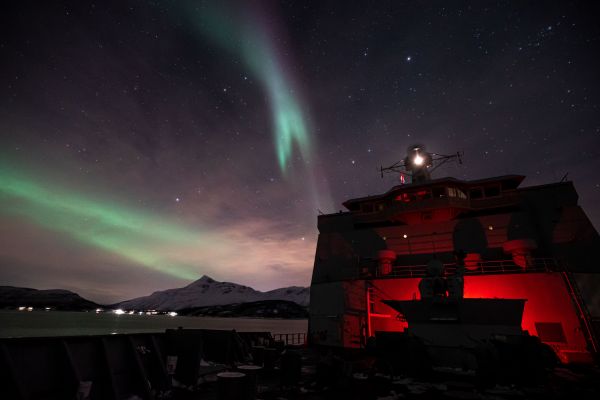 Northern lights in the Arctic region. Space weather phenomena like Aurora Borealis can have impact on military operations. Photo MCD, Jasper Verolme
When the weather is concerned, rain, wind, clouds, humidity and snow are the first characteristics that come to mind. The term ‘weather’ generally describes the atmospheric conditions that we experience here on Earth and is an important factor to consider in planning many kinds of activities, military operations included. The landing operation in Normandy in June 1944 is a good example in which weather forecasting was a crucial element of the mission’s success.[1] A more recent example is the intervention of the US in Venezuela, which was reportedly delayed by four days due to adverse weather conditions.[2]
Knowing ‘regular’ weather is, however, not always enough. Over the last decades, our operations have become significantly dependent on a variety of sensors and signals, which are sensitive to environmental circumstances other than just what normal weather typically describes. These include, among others, the intensity and frequency of the incoming light from the Sun, the signal propagation conditions in the various portions of the atmosphere, the changing magnetic field of the Earth and the presence of highly energetic particles, which may affect the behaviour and health of electrical components onboard spacecraft. The origin of many of these influences is in space, which is also why the term space weather is used to describe them collectively.
Space weather can have a wide spectrum of impacts on our systems. For instance, at times, the Sun can generate such intense radio emission that it jams our radio and radar systems, which may include satellite communications and navigation services. Especially now, in an era when signal jamming (and service denial in general) has been a tactic frequently employed by our adversaries, knowing the difference between the natural and man-made causes of these disturbances may be instrumental for decision-making. Further, if the cause of jamming is natural, it is also advantageous to know what to expect in terms of duration and extent of the event.
There is also another reason why the interest in space weather has been growing recently. Due to the structure of our magnetic field, it is especially the Arctic that feels many of these effects far more intensely than, for instance, the Netherlands. Now that our focus is partly shifting in the direction of the Arctic, understanding space weather phenomena may thus be especially useful if we want to be able to operate our systems in these regions reliably and accurately.
Many of us imagine space as an empty, dark volume in which our Earth orbits and the nature of which barely changes in time. This is, however, hardly the case in reality. Interplanetary space is filled with radiation, highly-energetic particles and magnetic fields that constantly interact with the Earth and, by extension, also with us and our technology. In the vicinity of the Earth, the most important external source of these particles, radiation and fields is our closest star, the Sun.
Even though humans have been studying the Sun for thousands of years, how certain solar processes operate is still, to this day, a mystery. For instance, the atmosphere of the Sun, which we also call the corona, is millions of degrees hot while the solar surface underneath (or, what we at least refer to as ‘surface’) is only a few thousands. The fact that we cannot explain this heating demonstrates that we are still not aware of some of the most fundamental processes that dictate solar activity.
One of the few things that we can predict about solar activity, however, is its regular 11-year-long cycle, during which the periods of high and low activity regularly exchange. The maximum of the current solar cycle took place in 2024,[3] and the activity is now steadily decreasing until we reach a minimum in five to six years. While during solar maxima the frequency of strong space weather events is higher, that does not mean that during minima strong events cannot occur. Actually, historically, some of the strongest space weather events have been seen during the declining phase of solar activity.[4]
In May 1967, the US Ballistic Missile Early Warning System showed signs of jamming.[5] Given the heightened tensions of the Cold War, it was only natural that the Americans immediately assumed that the Russians were trying to jam the system to start a large-scale attack and were ready to react. The Sun almost triggered World War III.
One of the symptoms of solar activity are the so-called solar flares, eruptions on the solar surface, often resulting in a large release of energy in the form of light. This emission includes a wide spectrum of frequencies, including radio that may interfere with our own signals. Sometimes, associated with these flares, are expulsions of mass and high-energy particles into the interplanetary space. Especially the former, which are also called coronal mass ejections, may also be a strong source of radio signals. Collectively, these irregular outbursts of radio from the Sun are termed solar radio bursts (SRB’s).
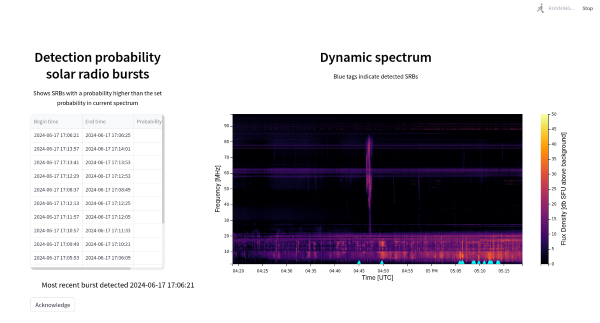 Screenshot from the DISTURB system as used by HNLMS Johan de Witt during Exercise Baltops24. Solar radio bursts can cause technical problems for equipment like radar. Photo METOC, Arie Verheij
During these bursts, the radio intensity of the Sun at certain frequency ranges increases well above normal levels, to the point that our own systems operating at these frequencies become jammed by it if the Sun happens to be in their field of view at the time. Especially systems that have a wide field of view (for instance, radars with a wide coverage) are thus at increased risk. Generally, lower frequencies are affected more often since these are easier to generate during the various physics processes as they require less energy.
While most of the well-known historical radio disruptions came from strong space weather events just like the one in 1967, a strong event is not always needed to create a technical problem. In November 2015, for instance, a medium-intensity solar flare created a radio burst that affected exactly the frequencies of secondary air traffic radars.[6] As a result, radars in Belgium observed dozens of fake echoes in the direction of the Sun, obstructing the tracing of real aircraft. In Sweden, the effects were so severe that it prompted the country to close its airspace for more than an hour.[7]
Solar radio bursts sometimes also affect our own maritime operations. That is why the Defence organisation is currently developing the so-called DISTURB system to constantly monitor radio signatures of the Sun.[8] A demonstration was carried out by the officers of the Royal Netherlands Navy, the Joint Meteorological Group, the German Bundeswehr and MARCOM as a contribution to Baltops24, during which solar radio bursts were also actually recorded.
Naturally, the frequencies affected can also be those corresponding to the GNSS (Global Navigation Satellite System) signals, leading to what may appear as GNSS jamming. The same holds for other satellite services, such as for communication. However, since GNSS frequencies are relatively high (1 to 1.5 GHz), strong GNSS disruptions due to radio bursts are expected to occur only roughly 9 times per solar cycle of 11 years.[9]
Compared to man-made jamming, solar radio bursts usually only last a limited time, typically minutes to tens of minutes. In addition, they are broadband disruptions, meaning that they influence an entire range of frequencies. This is typically not the case for man-made jammers, since jamming requires quite a lot of energy. Most artificial jammers are, thus, limited to a specific frequency channel (or multiple) of the service in use by their adversary.
As mentioned above, for a signal to be jammed by the Sun, the system must ‘see’ the Sun. For that reason, the Arctic is at a higher likelihood of experiencing such jamming during the day because there, the Sun stays at low elevations, meaning that the radios and radars looking at the horizon and just above it may notice this phenomenon more often. This is the case for Line-of-Sight communications at Earth, SATCOM, surveillance radars and most of the GNSS-signals. Of course, during the polar night, there is no risk of direct solar radio jamming.
One of the complications of the precarious situation in 1967 was the fact that along with radio disruption at VHF and UHF frequencies, long-distance HF (high-frequency) radio stopped working as well. At the time, since satellite communication services were not yet developed, the HF radio was the only method to communicate with the pilots over long distances efficiently. This means that had aircraft been sent to retaliate the presumed Russian attack, the pilots would have had no means of receiving further orders once underway. There would thus be no way to recall the mission.
Long-distance HF radio operates by refraction of the signal from the ionosphere (a charged layer within our upper atmosphere), meaning that its propagation is directly dependent on the condition of the ionosphere. Since the ionosphere responds strongly to space weather, HF radio generally suffers from space weather events much more than other radio types. The same holds for over-the-horizon radars that use the same principle and frequencies.
In mid-latitudes, HF radio blackouts generally follow strong solar flares, the high-energy light from which enhances the absorptive layer of the ionosphere where the HF signal becomes lost instead of being allowed to propagate further. Strong solar flares may lead to a complete blackout of all HF frequencies for up to hours in the regions with daylight. These blackouts can be especially problematic since often HF radio is used as a back-up in emergencies as an infrastructure-independent communication method when cell, internet and/or satellite systems fail. In September 2017, for instance, solar activity caused a blackout of HF radio precisely at the time when hurricanes Irma and Jose were causing significant damage to the Caribbean, meaning that unexpectedly, this service could not be used for emergency communication.[10]
In the Arctic, HF radio faces more frequent and long-lasting problems. The region lies in the vicinity of the magnetic pole, which is characterised by open magnetic field lines. The open field lines provide a path for highly energetic particles from space to enter the atmosphere. Just like high-energy light, these particles can enhance the absorptive layer of the ionosphere and lead to the loss of signals. However, compared to the emission of the light, particles generally keep storming in for much longer. As a result, HF radio blackouts in polar regions often last days. In other cases, the precipitation of particles in the region may enhance other layers of the ionosphere (the so-called auroral-E) and improve signal propagation over shorter distances.
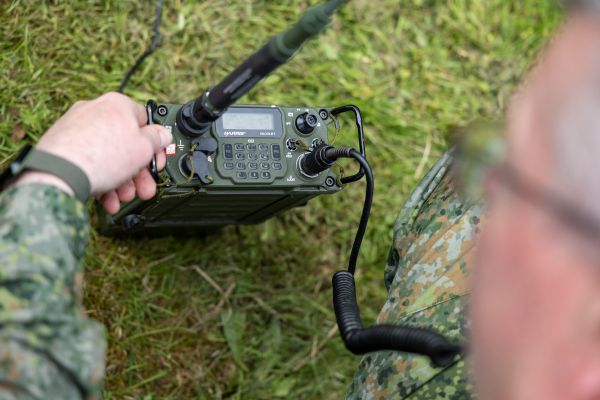 HF radio generally suffers from space weather events much more than other radio types. Photo MCD, Barend Westerveld
Next to these abnormalities due to enhanced absorption in the ionosphere, there is also another mechanism that frequently obstructs the use of HF. As mentioned above, solar flares are sometimes associated with mass ejections from the Sun that may also collide with the Earth and disturb the Earth’s magnetic field (though changes in the ‘plasma wind’ that the Earth faces from the Sun can also happen due to other phenomena and have the same effect). We feel this disturbance as a change to our Earth’s magnetic field – the geomagnetic field – and thus call it a geomagnetic storm.
After periods of geomagnetic storms, often the opposite is witnessed than during solar flares, and the ionosphere becomes depleted instead. If the ionosphere is too thin, it does not contain enough electrons to refract the HF signals, and these signals escape to space. This phenomenon also happens more frequently in polar regions and limits the use of higher HF frequencies.
Especially during solar maxima, HF propagation abnormalities due to these various mechanisms are a fairly regular occurrence, especially in the Arctic. It is, therefore, important to take this into account in mission planning, especially if these are to take place in the Arctic and rely on long-distance HF radio. In the Arctic, HF radio may be of special importance as many SATCOM services do not provide sufficient coverage in the region.
The fact that the particles from space have an easier way to penetrate into the Earth’s atmosphere in the Arctic is also the reason why this region is known for one of the world’s most beautiful natural phenomena – the northern lights, or Aurora Borealis. These lights are caused by interaction of the incoming particles with gasses in our atmosphere, and depending on the reacting gas, they display a variety of vibrant colours; from purple, through bright green to red.
However beautiful they are, in especially active conditions, northern lights can be intense enough to light up the night and take away the (dis)advantage of darkness. This was, for instance, the case during the Second World War, when the auroral light in September 1941 allowed the British to carry out a raid on a German supply base in the Baltic Sea and the Germans to bombard Leningrad.[11]
In addition, and more importantly nowadays, the phenomenon of aurora also interacts with our radio signals and may cause their scattering. In radar operations, this is referred to as auroral clutter.[12] Just like other sources of radio or radar clutter, it may significantly limit ranges and thus radar detection capability. This backscatter may also further appear in some radio communications through the atmosphere as increased noise.
Trans-atmospheric radio links may also be impacted in regions outside of those experiencing aurora. In March 2002, during Operation Anaconda in Afghanistan, a Quick Reaction Force was directed to rescue units from the summit of Takur Ghar. While underway, a message was sent via SATCOM (satellite communications) letting the crew know to avoid the mountain top due to the presence of Al Qaeda and Taliban fighters. The message was never received, however, and the helicopter landed under intense fire, with the mission eventually leading to loss of life.[13]
During times of increased geomagnetic activity, the structure of the ionosphere can often become disturbed. Disturbances cause a so-called scintillation of the signal, which is a rapid variation in the signal’s amplitude and phase as it is travelling through its layers. Beyond a certain level of scintillation, the signal may become completely useless. Strong scintillation is more likely to happen in Arctic and equatorial regions compared to mid-latitudes.
Strong ionospheric scintillation affects many of our signals propagating through the atmosphere, including SATCOM at lower frequencies (less than a few GHz) and less robust GNSS services. Especially in the Arctic, the coverage of satellites is generally worse than in mid-latitudes, and some of them only rise to lower elevations above the horizon. This means that the signal has to travel through the disturbed ionosphere longer and thus becomes more distorted. Plus, while in mid-latitudes and equatorial regions, it is usually straightforward to connect to a different satellite of the service with a link that does not suffer from these effects, due to the worse coverage in the Arctic, this is not always possible.
A user may perceive this phenomenon as a simple disruption of service. Strong scintillation in the Arctic occurs largely around midnight and noon,[14] but during very strong geomagnetic storms the ionosphere may be strongly disturbed for hours to days.[15]
Such ionospheric changes also result in the fact that the refractive index, important for signal propagation, varies strongly in time and space. In that case, radar users may notice that their signals no longer propagate along the shortest paths across the atmosphere and ranging accuracy thus becomes impacted.
In August 1972, near the North Vietnamese port of Hai Phong, dozens of sea mines spontaneously exploded, without any object passing by.[16] These sea mines were designed to sense changes in the magnetic field, assuming that any variations would be caused by passing ships. At the time, however, there were none – the variations were caused by the Sun.
The geomagnetic field is continuously influenced by the plasma wind that comes from the Sun. Because of the open magnetic field lines in the Arctic, it is this region that feels this activity the strongest. In extreme solar events, such as in August 1972, the changes in the geomagnetic field are so large that they are felt all over the globe, such as was the case of Vietnam. Geomagnetic activity may influence the accuracy and reliability of any system making use of magnetic sensing, including magnetic detection (for instance of submarines), sea mines and magnetic navigation.
The influences of a changing magnetic field may also have wider-scale effects. Following the laws of electromagnetism, magnetic field variations create electric currents. These direct currents may enter power systems and transformers, and since transformers are designed to work with alternating currents instead, they can become saturated and damaged. Due to this phenomenon, for example in March 1989,[17] a solar storm caused several millions of people to lose power for nine hours in Quebec, Canada. Actually, one of the first mentions of space weather goes back to the Carrington event in 1859, the strongest space weather event measured to date, during which the induced currents were so strong that they disrupted telegraph lines globally and even caused their operators to receive electric shocks.[18]
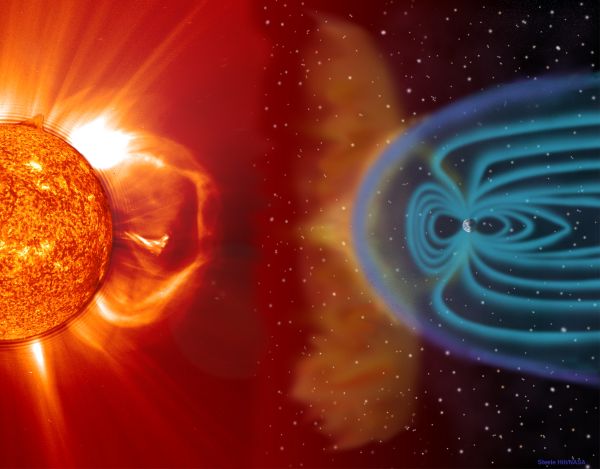 A coronal mass ejection (CME) blasts from the Sun’s surface in the direction of Earth, where the blue lines represent magnetic field lines that (mostly) deflect the blast. CME’s take some time to reach Earth which gives a window to issue warnings. Photo NASA Goddard Space Flight Center
To this date, these currents affect the performance of power grids in Nordic countries, especially in regions where the ground allows the currents to accumulate. During strong solar activity, one must thus not only beware of the integrity and accuracy of their signals and sensors but also of the robustness of their power infrastructure to unexpected currents.
Even though the Sun has been affecting the reliability of our systems and infrastructure ever since their beginnings, proper awareness of space weather effects among the users of these systems is often still lacking, especially at latitudes where these events are not felt so strongly. Part of the reason why this is the case may be the fact that the actual system effects, such as temporary losses of signal and increased radio noise, can be easily attributed to a variety of technical problems that occur in these systems frequently. Such incorrect attribution may then lead to waste of resources with the systems being flagged as inoperable until they receive a technical check later and until it is confirmed that they mysteriously started working according to the specifications again.
For this reason, if odd technical issues occur, especially with systems using radio signals and especially if these affect multiple systems simultaneously, consulting the local space weather centre may be advantageous before classifying the issue as purely technical. Frequently, all that is required is determining whether an event has indeed taken place at the given time and if it could have impacted the given location and frequencies.
Of course, in actual operational scenarios, understanding space weather effects is not only needed to properly interpret technical malfunctions, but also to determine what the correct course of action should be to have them resolved. Depending on the space weather event and the affected systems, there are various mitigation strategies from which the system operator may choose, depending on the type of situation they are in and the resources they have available.
Just like with terrestrial ‘regular weather’, one of the most important strategies for mitigation is actively monitoring current conditions and their forecasts. Many countries issue their own space weather products with forecasts for the following days, just as it is done for terrestrial weather. In the Netherlands, a space weather product is issued by the earlier mentioned Joint Meteorological Group. For instance, it takes one to three days for a coronal mass ejection to arrive from the Sun, which gives us a window to issue warnings. It should be noted, however, that the accuracy of space weather forecasts is still limited due to the fact that to a great degree, our detailed understanding of the underlying processes is lacking. As a consequence, some phenomena (such as the timing of solar flares) are still impossible to forecast.
Unfortunately, we also cannot always accurately predict how severely a system will be impacted by a specific event. System response to space weather depends on many factors with the often unknown internal design of it being one. For instance, less advanced and therefore cheaper, civilian GPS will be inaccurate at much lower levels of ionospheric disturbance than military GPS. The military should always, when possible, make use of dual-frequency military-code GPS, in short MilGPS.
If an event is expected that may disturb a system (or a service) essential for a mission, this mission can be postponed or fast-tracked. If fast tracking or delaying is not possible, one may choose to deploy additional systems to ensure redundancy. For instance, if the beginning of a mild particle storm is observed that causes an HF blackout, but does not significantly impact the operations of satellites, commanders planning Arctic operations dependent on long-distance communication may prefer to rely more heavily on super high-frequency SATCOM over HF radio. Likewise, if a strong geomagnetic storm is predicted that may disturb the ionosphere significantly in the region and impact SATCOM, carrying HF radio as a backup for long-distance communication may be a good option.
System redundancy can also be implemented on a permanent basis. For instance, in June 2024, during Baltops24, HNLMS Johan de Witt experienced significant solar radio burst effects that also affected the availability of GPS for a specific duration of time. However, the inertial navigation system of the ship was more than accurate enough to be able to bridge that timeframe.
If temporary or permanent redundancy is not possible, system operators who experience a blackout may decide to try other system settings, such as different frequencies, if they have these available. For instance, radio bursts typically only affect a certain portion of the radio spectrum, so trying out another channel may resolve the issue. For HF blackouts due to solar flares, lower frequencies of the HF spectrum are affected much more, so switching to the higher ones may work to restore communication. Overall, system users should be aware of the potential vulnerabilities of their system to these effects and what may be attempted to overcome them.
To achieve this level of understanding, in the longer term, raising awareness among the system users, commanders and other decision-makers is crucial by appropriate training. This training must be developed in such a way that it directly links the observed space weather conditions to system effects, ideally in the language of the system user.
On the practical side, it is important to keep participating in exercises that take place in Arctic regions where these effects happen on a more regular basis and share know-how with allies who have more experience in this area. This includes Nordic countries, which are used to experiencing these effects and correcting for them during their operations. This can be complemented by exercises that simulate operations in denied, degraded, and disrupted operational environments.
However, space weather does not only have to be a pitfall, especially if combined with a good preparedness level and the knowledge of potential impacts on the adversary. For instance, knowing that specific systems of the adversary are not currently operational, or simply being better prepared for these impacts, can lead to a tactical advantage. This is called a ‘Tactical Exploitation of the Environment’, and it also forms a focus of planned future research within the Ministry of Defence.
Space weather, just like regular weather, is here to stay. It can cut our communications, degrade navigation accuracy, obstruct our radar vision and even damage our power systems. Especially in the Arctic, these effects are difficult to ignore when safe and undisturbed operations are a priority.
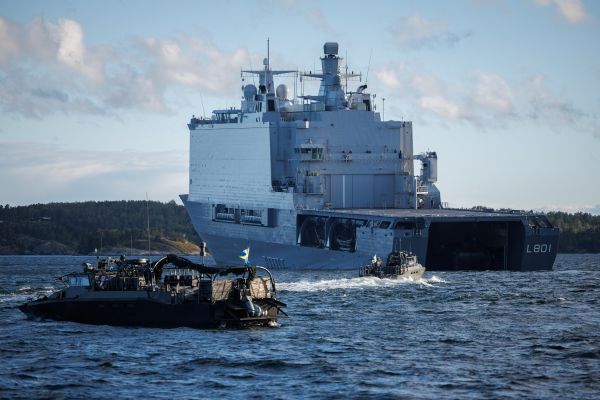 HNLMS Johan de Witt participated in Exercise Baltops24. During the exercise, the ship experienced loss of GPS for a specific duration as a result of solar radio bursts. System redundancy mitigated the effects: the ship’s inertial navigation system was more than accurate enough to bridge that timeframe. Photo MCD, Sjoerd Hilckmann
Understanding and interpreting space weather, however, remains a challenge. The effects of space weather are much more difficult to understand intuitively when compared to terrestrial weather as they are often not visible to humans other than through the responses of their systems.
Our understanding of solar activity is still limited. So is our ability to accurately predict system responses due to the fact that system behaviour frequently depends on the often unknown details of its internal design. These two aspects combined mean that it is still very difficult for us to issue accurate forecasts and corresponding detailed advice for system users.
Still, monitoring current conditions and attempting to forecast them for the hours and days to come remains the best practice to mitigate the effects. With a sufficient warning in advance, missions potentially sensitive to these effects can be delayed or fast-tracked, or decisions can be made to deploy less vulnerable equipment instead. Interpretation of atypical technical malfunctions, especially those involving radio signals, can happen with the advice of space weather experts to avoid attributing these effects to the adversary or simply labelling the system as dysfunctional. To achieve this insight, it is pivotal to keep increasing the awareness of these effects across all levels of the organization. Responsiveness and adapting to disturbances, in the planning and execution of military operations, starts with training and educating officers and system operators.
In the way ahead, there is still a long way to go before space weather is handled the same way as ‘regular’ weather. However, if safe and undisturbed operations all the way to the Arctic is what is required, then nothing ought to discourage us from trying.
[1] Royal Meteorological Society, ‘How weather forecast made history — the D-Day landings’. See: https://www.rmets.org/metmatters/how-weather-forecast-made-history-d-day-landings.
[2] Gareth Evans, ‘Spies, drones and blowtorches: How the US captured Maduro’, BBC, 4 January 2026. See: https://www.bbc.com/news/articles/cdred61epg4o.
[3] SIDC, ‘SC56 maximum in October 2024’. See: https://www.sidc.be/article/sc25-maximum-october-2024.
[4] N.A. Frissell et al, ‘High-frequency communications response to solar activity in September 2017 as observed by amateur radio networks’, Space Weather 17 (2019) (1) 118–132. See: https://doi.org/10.1029/2018SW002008.
[5] D.J. Knipp et al, ‘The May 1967 great storm and radio disruption event: Extreme space weather and extraordinary responses’, Space Weather 14 (2016) (9) 614–633. See: http://dx.doi.org/10.1002/2016SW001423.
[6] Christophe Marqué et al, ‘Solar radio emission as a disturbance of aeronautical radionavigation’, Journal of Space Weather and Space Climate 8 (2018) Article A42. See: https://doi.org/10.1051/swsc/2018029.
[7] AP News, ‘Solar storm knocks out flight control systems in Sweden’, 4 November 2015. See: https://apnews.com/article/efd138980b9e473e805221439c71a031.
[8] Netherlands Ministry of Defence, ‘Instrument Disturb bepaalt: zon of vijand’, 30 May 2024. See: https://www.defensie.nl/actueel/nieuws/2024/05/30/instrument-disturb-bepaalt-zon-of-vijand.
[9] Xinan Yue et al, ‘The effect of solar radio bursts on GNSS signals’, in: Natalia Buzulukova (ed.), Extreme Events in Geospace: Origins, Predictability, and Consequences (Elsevier, 2018) 541–554.
[10] Frissell et al, ‘High-Frequency Communications Response to Solar Activity’.
[11] J. Janssens et al, ‘Space weather: The impact on security and defense’, in: K.-U. Schrogl et al. (eds.), Handbook of space security (Cham: Springer, 2019). See: https://doi.org/10.1007/978-3-030-22786-9_94-1.
[12] S. Simpson, ‘U.S. Air Force Predicts Space Weather Impacts on Technological Systems’, Space Weather 2 (2004) (12). See: https://doi.org/10.1029/2004SW000108.
[13] Michael A. Kelly et al, ‘Progress toward forecasting of space weather effects on UHF SATCOM after OPERATION Anaconda’, Space Weather 12 (2014) (10) 601–611. See: https://doi.org/10.1002/2014SW001081.
[14] Knut Stanley Jacobsen and Michael Dähnn, ‘Statistics of ionospheric disturbances and their correlation with GNSS positioning errors at high latitudes’, Journal of Space Weather and Space Climate 4 (2014) Article A27. See: https://doi.org/10.1051/swsc/2014024.
[15] Knut Stanley Jacobsen et al, Scintillation in the Arctic during the May 2024 Mother’s Day storm, Journal of Space Weather and Space Climate 15 (2025) 57. https://doi.org/10.1051/swsc/2025045.
[16] Scientific American, ‘A solar storm detonated U.S. Navy mines during the Vietnam War’, 14 November 2018. See: https://www.scientificamerican.com/article/a-solar-storm-detonated-u-s-navy-mines-during-the-vietnam-war/.
[17] BBC, ‘What the 1989 storm did to Quebec’. See: https://www.bbc.co.uk/programmes/w3ct4x8h.
[18] Jasna Hodžić, ‘The Carrington Event of 1859 Disrupted Telegraph Lines. A “Miyake Event” Would Be Far Worse’, Jstor Daily, 7 September 2023. See: https://daily.jstor.org/the-carrington-event-of-1859-disrupted-telegraph-lines/.