
Image
This year marks the 80th anniversary of awarding the Netherlands’ highest military decoration for bravery to Second Lieutenant George Maduro. He was inducted as a Knight of the Military Order of William, 4th class, on May 9, 1946, by Royal Decree No. 6, in recognition of his heroic actions six years earlier, on May 10, 1940.[1] It was the first and only time that a Dutchman of Jewish-Caribbean descent received this honour. Yet, despite it being generally known that Maduro is the namesake of Madurodam, the open-air miniature park in The Hague with reduced-sized replicas of prominent buildings and infrastructure of the Netherlands, the man himself still remains largely unknown. So it is appropriate to pay more attention to his life.
This story about George Maduro is not intended as a hagiography but rather as an inspiration; particularly at a time the international rule-based order is under fire. Maduro’s story shows how a carefree student transforms into an officer and resistance fighter, who takes responsibility and rises above himself as geopolitical circumstances deteriorate while also encountering anti-Semitic prejudice in the Netherlands. Besides considerable boldness, Maduro’s perseverance and humanity were particularly striking.
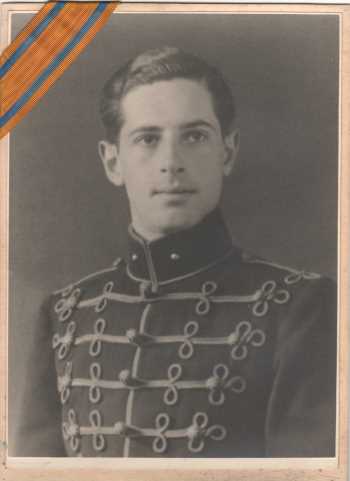
From a careless student George Maduro would transform into an officer and a resistance fighter. Photo Maduro family archive
This article aims to commemorate the 80th anniversary of George Maduro’s Military Order of William by painting a picture of his unique traits and struggles as a Jewish-Caribbean student in the Netherlands, as a cavalry officer and as a member of the Dutch resistance movement.
Student in the Netherlands
George Maduro was born on Saturday, 15 July 1916 at nine o’clock in the morning in a stately home in Scharloo, a residential area on the outskirts of Willemstad, Curaçao. His birth certificate initially listed his names as George Joshua Levy Maduro. The Maduro family were members of the Sephardic Jewish community. Their ancestors came from the Iberian Peninsula, but the Jews were expelled from there in the 15th century. Via Amsterdam, they ended up in Curaçao in the mid-17th century. [2] One of Maduro’s forefathers started a department store in Willemstad in 1837, which quickly grew into a powerful enterprise under the name S.E.L. Maduro & Sons, focusing on shipbuilding, maritime transport and banking. Soon after, offices were also opened in Havana and New York.[3] The corporation survived many crises and still exists today. It is now called ‘Maduro Shipping’.[4] Maduro’s father had quickly risen to deputy manager of S.E.L. Maduro & Sons while George himself enjoyed a privileged childhood with a nanny and many servants. A year after his birth, his sister Sybil was born.[5]
In 2016, 100 years after Maduro’s birth, Kathleen Brandt-Carey published a biography of the life of George Maduro called Ridder zonder vrees of blaam (The English title of the book is Knight without fear and beyond reproach), in which Maduro’s personality is particularly well presented. Brandt-Carey writes that the Maduros settled in The Hague in 1926 to provide their children with a good education. After a year, Maduro’s parents left for Paris while he initially stayed with a family friend and later moved to the Aronsteins in The Hague. Carl Aronstein was a vice admiral in the Royal Netherlands Navy and knew the Maduro family from the time when he frequently moored his naval ships in Curaçao. Aronstein was Jewish as well and married to Jeanne Vaillant, a Protestant and the granddaughter of a reverend.[6] This was an unusual relationship because, although mixed marriages between Jews and Christians were not forbidden, they were still very uncommon from a social point of view. In the past, the Netherlands was known for its tolerance, but when it came to marriages, people often married within their own religious community.[7] Maduro’s romantic involvement with Hedda de Haseth Möller, for example, faced many obstacles. Their love relationship had lasted for several years. However, Hedda’s father had always been vehemently opposed to their relationship because Maduro was Jewish. The Maduros and the Möllers, who had known each other from Curaçao, fell out after years of close friendship.[8]
The Aronsteins were explicitly secular and very pleased being foster parents of Maduro. Maduro’s parents also gradually became more secular. In 1928, their son’s name was officially amended by the Curaçao court. Initially, in accordance with family traditions, Maduro was given Jewish second names, but these names were changed to George John Lionel. It was also customary within the Curaçao Sephardic community to give children English names.[9]
At the Nederlandsch Lyceum in The Hague, Maduro met Erik Hazelhoff Roelfzema, who later became a well-known Dutch war hero, aka the ‘Soldier of Orange’. Hazelhoff was a prominent member of the editorial board of the school newspaper Het Lyceum, for which Maduro had written an article.[10] During his secondary school years, Maduro was always very concerned about his academic performances; this was also due to the pressure his father put on him. Maduro was intended to be the first member of his family to attend university. To this end, he first had to complete his secondary education, but he sometimes failed his exams. On the other hand, he was very sociable and enjoyed many school parties. At the age of 14, he already had a tailor-made dinner jacket for his various social engagements, and many girls at school were particularly charmed by the handsome George.[11]
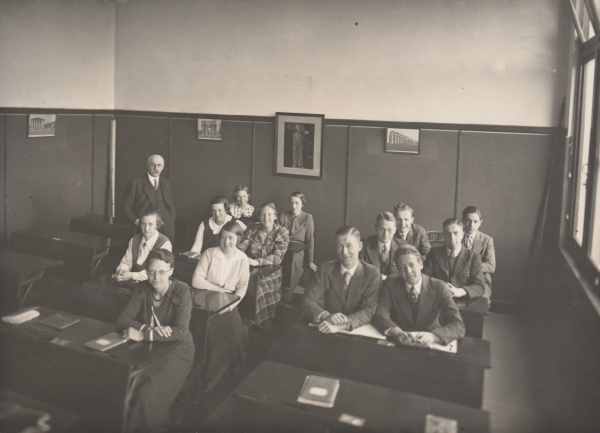
As a student at the Nederlandsch Lyceum in The Hague, at the back of the classroom on the right. Maduro was destined to become the first in his family to go to university. Photo Maduro family archive
With great determination, Maduro obtained his pre-university degree[12] in 1934 and a new era dawned for him: Leiden University. He went on to read law and became a member of the Leidsche Studenten Corps (LSC), which was a Dutch male fraternity.[13] He spent many evenings at the LSC’s clubhouse and participated in numerous social events and gala evenings organised by the LSC.[14] In a letter to his father, Maduro stated that he struck a senior student who had treated him unfairly during a hazing ritual.[15] It fits the image of Maduro, who, when push came to shove, demonstrated his boldness.
Cavalry officer
In September 1936, Maduro received his draft notice and submitted a request to serve with the 1st Hussar Regiment. He was soon selected for the School for Reserve Officers for the Cavalry (SROC) at the Prince William III Barracks in Amersfoort.[16] The SROC was very much a preserve of the Dutch upper class and noble families.[17] As such, it was a step up the social ladder for Maduro, because although he came from a wealthy family and was a member of the prestigious LSC, he was also Jewish and from Curaçao and, therefore, not fully accepted by the Dutch establishment. Latent anti-Semitism was not uncommon in the Netherlands before the outbreak of the Second World War, characterised by economic restrictions such as occupational bans, social exclusion and anti-Jewish stereotypes in everyday conversations.[18] These principles of discrimination did not apply at the SROC, where no distinction was made and everyone was treated equally.[19]
Maduro was assigned to Course 20 of the SROC. The commander of the SROC at the time, Captain C.L. Hollertt, proved to be a role model who did much to develop the character of the cavalry officers in training and helped them become familiar with horses. According to a classmate of Course 20, Just Koch,[20] Maduro was initially afraid of horses, but Captain Hollertt helped him overcome this fear.[21] Despite the challenges and Spartan conditions, Maduro enjoyed his time at the SROC. He loved sports and learned not only horse riding but also fencing. He thoroughly enjoyed those aspects of military life and looked particularly smart in his ceremonial cavalry uniform. After the short Christmas break, he reported back to Amersfoort on 4 January 1937. Three days later, he and the other SROC students formed the guard of honour along the Groenmarkt in The Hague for the wedding procession of Princess Juliana and Prince Bernhard, which Maduro thoroughly enjoyed.[22]
However, Maduro's SROC training did not all go smoothly. During the winter months of 1937, he grew increasingly tired and, given his Curaçao background, had difficulty adapting to the cold weather. In addition, it is suspected that Maduro suffered from Raynaud’s disease, a circulatory disorder that restricts blood flow to the extremities and causes fingers to turn blue and function less well in cold weather. Because of this physical condition, Maduro was prone to clumsiness and could fumble when fastening the straps while saddling a horse. He also initially appeared hesitant when giving orders, which was not becoming of a young officer as was duly noted by the teaching staff. He was eventually passed over for promotion to sergeant, and to make matters worse, a horse stepped on his foot in the early spring of 1937. This injury caused him to fall further behind during field exercises. The warm spring of 1937 brought relief for Maduro, and he sprung back to life. His fatigue had disappeared and his foot injury had healed. Determined to successfully complete officer training, Maduro managed to pull himself together. He resumed full participation in field exercises and was made commander during several exercises to test his leadership skills. He performed well in these roles, which gave him the confidence he needed.[23] Ultimately, after these setbacks, he was promoted to temporary sergeant on 15 May 1937.[24]
During the concluding exercise, he even received a compliment from the cavalry inspector, Colonel Herman van Voorst tot Voorst, for skilfully dismantling a machine gun nest. This skill proved to be very useful later in May 1940. On 24 July 1937, he and the other students passed the officer’s examination but were not yet promoted. After the summer holidays, Sergeant Maduro reported to the 4th Half Regiment of Hussars in Deventer. His task was to train conscripted reservists in military skills.[25] Maduro made friends in the cavalry, such as Bib van Lanschot, a descendant of a well-known banking family from Vught, who had become a professional soldier via the Royal Military Academy in Breda. Van Lanschot was part of Course 19, which preceded Maduro’s course. Maduro also became acquainted with Oncko Wttewaall van Stoetwegen; they were classmates in Course 20. Wttewaall was the son of a strict Calvinist tax inspector from Rotterdam and belonged to Dutch nobility, with whom Maduro developed a true camaraderie.[26]
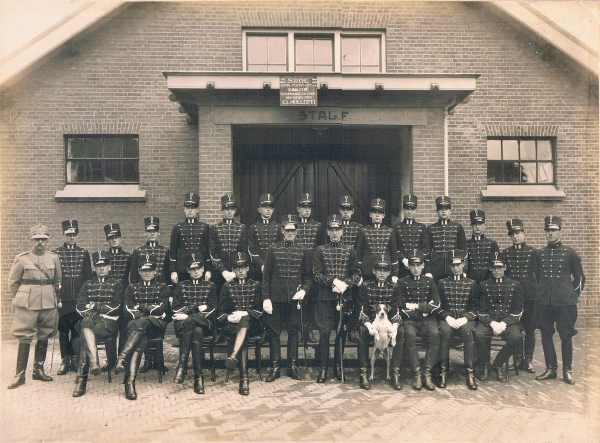
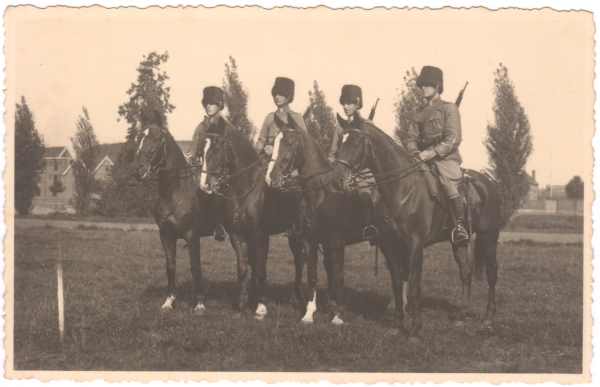
Group picture of participants in the 20th course. Maduro (sixth from the left, standing) became close friends with Oncko Wttewaall van Stoetwegen (front row, sitting on the right). Photo Maduro family archive
Maduro was appointed Cornet, the lowest officer rank in the Dutch cavalry, on January 1, 1938, and subsequently left active service.[27] He returned to Leiden to resume his studies, and he also became very active in student social life again. That summer, together with some LSC friends, Maduro attempted to steal back an old figurehead, called De Loden Verrader, from a Royal Netherlands Navy gunboat as a prank, since the figurehead was officially property of the Maduros. The caper failed but did not lead to any arrests as the first officer, to his credit, was able to appreciate this youthful joke.[28] The Dutch press, however, got wind of this bold attempt to steal back a family heirloom and wrote all sorts of colourful stories. They were full of admiration for the daring action of Maduro and his friends. This audacious caper, despite its failure, made him temporarily famous in the Netherlands.[29]
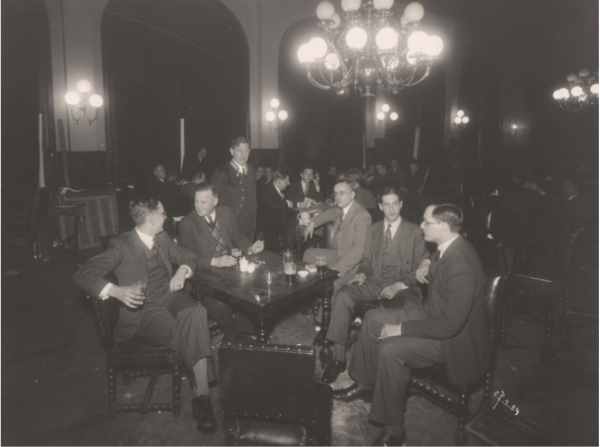
After leaving active service in 1938 Maduro, second from the right, became very active in student social life again. Photo Maduro family archive
After the summer of 1939, due to rising tensions in Europe, mobilisation was announced in the Dutch army and Maduro was summoned to report for active military service again. This time, Maduro was stationed at the Cavalry Depot at the Alexander Barracks in The Hague, the very place the International Criminal Court has been located since 2016. Maduro’s job was to train new hussars. By then, the hussars were being trained not only on horses but also on bicycles and motorcycles. On December 1, Maduro was finally promoted to lieutenant, with a mounted swearing-in ceremony taking place the following day. Two days later, the traditional cavalry gala dinner took place at De Witte Club in The Hague and was attended by Prince Bernhard. In January 1940, Maduro had returned to Leiden and won the decisive sabre fencing competition for the LSC during an Interacademial Assaut. Maduro became the man of the hour at LSC’s clubhouse in Leiden.[30]
On Friday, May 10th, 1940, the war also came to the Netherlands. Maduro had been called up again and was again stationed at the Alexander Barracks.[31] In the early morning, around 4:00 a.m., the Alexander Barracks were bombed by German aircraft as part of the ‘Battle of the Residence’, in which the three airfields around The Hague were attacked, being Ypenburg, Ockenburg, and Valkenburg.[32] Around 7:00 a.m., reports came in that the three airfields had been occupied by German paratroopers. A total of three corporals and 63 hussars and many horses were killed in the bombing of the Alexander Barracks, and more than 150 soldiers and civilians were wounded. The hussars were largely reservists called up in response to the threatening geopolitical situation.[33]
The officers of the Depot Cavalry were billeted, not with the men, but in homes around the city. Maduro was staying with Vice Admiral and Mrs Aronstein in the Archipel neighbourhood in the centre of The Hague, several kilometres away, and therefore escaped the bombing unscathed. Maduro had been awakened by the bombing that morning and rushed to the barracks to help extinguish the fires and treat the wounded. Approximately 600 cavalrymen had survived the bombing.[34] A battle report states that hussars at the Frederik Barracks, opposite the Alexander Barracks, had escaped and initially fled to the nearby dunes. Some of them formed a new detachment in the early morning. Led by Lieutenant Maduro, this detachment set off with six tractors[35] towards Juliana van Stolberglaan to assist in the defence of The Hague. On the way, they lost three tractors due to breakdowns.[36]
The July 1940 edition of Militaire Spectator contains a detailed account of the fighting around The Hague. In his article ‘De Infanterie Compagnie te Velde’ (The Infantry Company in the Field), Lieutenant Colonel of the General Staff van Hilten wrote that at around 9:00 a.m., Maduro was ordered to take a detachment consisting of a sergeant, 14 enlisted men, a machine gun and three tractors, to go to the Vliet to reinforce the Dutch defensive positions. The Vliet is part of a larger canal that runs from Leiden to Rotterdam. Around 10:00 a.m., Maduro arrived in Voorburg, where he left the tractors under the guard of the sergeant and four men. With the rest of the detachment, Maduro proceeded to the Oude Tolbrug, which was a little further away. Once there, he contacted the Dutch troops stationed at the nearby Villa Heeswijk. It soon became apparent that German paratroopers, who had landed at Ypenburg Air Base, had managed to break out and had subsequently taken possession of Villa Dorrepaal on the other side of the Vliet. Maduro indicated to an infantry captain on the spot that he wanted to recapture the villa to push back the Germans. The captain asked him to wait so that the action could be coordinated with higher command. At 12:30 p.m., Maduro received a phone call at Villa Heeswijk and was ordered by a major, who had been briefed by the captain, to storm Villa Dorrepaal. The major provided Maduro with a Böhler 4.7 cm anti-tank gun, aka Pag.[37] Maduro divided his detachment into three groups: two attack groups and a machine gun group. After the anti-tank gun had arrived, he ordered the sergeant major, who commanded the gun group, to set it up in a meadow and fire five shots on his command.[38]
From left to right temporary sergeants Bierens de Haan, Van Ogtrop, Maduro and Rengers Hora Siccama (all from SROC course 20). The photo was taken on 1 October 1937 at the Boreel barracks in Deventer. Photo Maduro family archive
In his Militaire Spectator article, van Hilten quotes Maduro, who had written an extensive battle report on the storming of Villa Dorrepaal on May 23, 1940. He stated: ‘I informed both assault groups that the attack would only stand a chance of success if the charge was carried out as quickly as possible, so everyone had to run as fast as they could. The ensign ran at the rear to urge them on to greater speed if necessary. When I was fully prepared for the attack, I gave the agreed signal to the sergeant major and immediately after the fifth shot I stormed across the Oude Tolbrug, followed by the first and second groups. During this attack, there was continuous firing from the villa, but the fire decreased as I approached the villa. Entirely in accordance with my plan, I entered the garden of the villa and onto a terrace. I was the first to enter the house, immediately followed by a corporal from the anti-aircraft artillery. Inside the house, I heard loud footsteps and the crunching of glass shards covering the floors. I pushed on to the hall and a moment later met the sergeant, who had also entered the villa with his group. I ordered him to surround the villa, set up posts to prevent the Germans from escaping from the house, and cordon off the area. I searched the house myself and finally came to a cellar door, which I opened. Four old ladies immediately came out and told me that there were Germans in the cellar. I shouted into the cellar: ‘Hände hoch, nicht schiessen’ (Hands up, don’t shoot), to which they replied: ‘Wir schiessen’ (we’ll shoot). The corporal from the anti-aircraft artillery then descended the cellar stairs on my orders and fired into the cellar. The direction of the cellar entrance was perpendicular to the actual cellar, so I could not see directly into it. Immediately afterwards, I heard cries of pain: ‘Bitte nicht mehr schiessen’ (Please don’t shoot anymore), whereupon I ceased fire and ordered the Germans to come up one by one with their hands raised. Seven German paratroopers came up one after the other, were disarmed by my men and led outside. Two of these Germans were slightly wounded. Outside, four more Germans were brought forward, who had been found behind the grounds. I wanted to order the ensign to take the 11 prisoners of war away, but a passing captain informed me that this had to be done under the supervision of an officer. I handed over command to the ensign, instructed him to guard the villa and took the prisoners of war away to the Laan Copes van Cattenburg’.[39]
Maduro’s account is corroborated by the statement of private Van den Manakker, who was assigned to one of the two attacking groups. Van den Manakker said: ‘Shortly after half past three, the anti-tank guns were ordered to fire five shots at the villa. Lieutenant Maduro rushed ahead, immediately followed by soldier A. Glim, a corporal and me. The lieutenant and the corporal were the first to enter the villa. When Lieutenant Maduro’s group stormed across the bridge, we came under fire from the Germans in the houses until we had safely crossed the bridge. Then the firing stopped. There were casualties on the bridge; after the assault, I took the wounded to the barn. I arrived at the front of the villa. The door had been broken open. On Lieutenant Maduro’s orders, I stood guard at the door. After half an hour, the lieutenant came out of the villa. The captured Germans were taken to a barn under escort.’[40]
The recapture of Villa Dorrepaal was a tactical boost for the Dutch troops. The adjacent Park Leeuwenbergh was immediately occupied by Dutch soldiers. According to military historian Eppo Brongers, Maduro’s ‘lightning-fast and well-considered action’ had so overwhelmed the German paratroopers that they were unable to reorganise properly.[41] In addition, military historian Cees Schulten explains that the recapture of Villa Dorrepaal broke through the German defensive lines around Ypenburg Airport. This triggered the Dutch counterattack to recapture Ypenburg Airport from the Germans, further to the southwest, towards Rijswijk near the Hoornbrug. By the end of the afternoon, Ypenburg was in Dutch hands again.[42] After the war, the Dutch soldiers directly involved in the storming of the villa were, therefore, honoured, because they were mentioned in Maduro’s battle report. The corporal mentioned in Van den Manakker’s report is Corporal Hekhuizen, who was later awarded the Bronzen Leeuw (Bronze Lion), the second highest Dutch award for bravery. The privates Glim and Van den Manakker received the Bronzen Kruis (Bronze Cross), also a high Dutch decoration for bravery, for their performance in the attack. The leader of the second assault group, sergeant Volkeri, was also awarded the Bronzen Kruis.[43]
The ensuing days of war in May 1940 were rather chaotic, and many rumours circulated about a the existance of a pro-German ‘Fifth Column’. Maduro was after the attack assigned to guard Hollands Spoor railway station as well as other important and suspicious locations in The Hague, including Hotel Mitropa.[44] According to a report by Maduro, infantrymen had called on his assistance to search the hotel at around 3:00 p.m. on 13 May 1940. After forcing the door open, the infantrymen took the pub owner, his wife and another gentleman outside while Maduro and his hussars searched the hotel. There, they saw a photo of the pub owner in a German army uniform. Suddenly, they heard shots outside and saw both men lying on the ground seriously injured while the woman had injuries to both hands. According to a medical aid station, one of the men had been hit by a dumdum bullet.[45] The incident would be further investigated by The Hague police.[46] The case would have further consequences for Maduro.
Member of the Dutch resistance
After the capitulation, Maduro was demobilised and returned to Leiden, where he became increasingly involved in resistance activities in the months that followed. Initially, these activities involved espionage work, consisting of mapping out where German troops were stationed. Maduro’s cavalry friends, Van Lanschot and Wttewaall, also went to Leiden to study after their demobilisation. Van Lanschot even joined the LSC. According to Van Lanschot, this quickly became a cover for organising actions against the German occupiers. After everything that had happened in May 1940, studying was no longer their priority, according to Van Lanschot.[47] Within the LSC, a group of demobilised reserve officers quickly engaged in resistance activities. The emerging resistance was keen to recruit men like Maduro, Van Lanschot and Wttewaall, because of their military experience. For Maduro, no persuasion was needed: liberating the Netherlandse from occupation was a cause he was passionate about.[48]
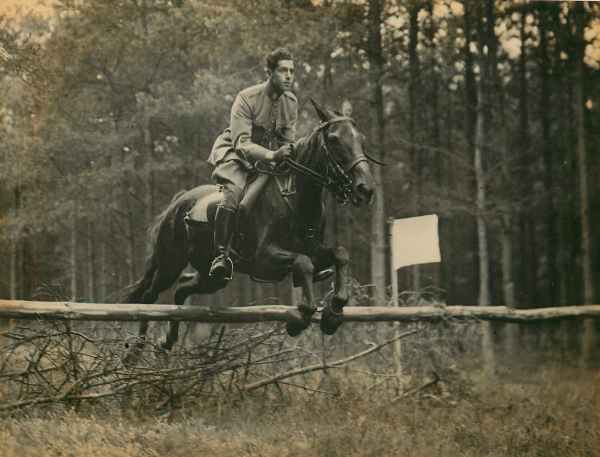
As a cavalry officer Maduro became a skilled rider. The emerging resistance in the Netherlands was keen on recruiting men like Maduro, Van Lanschot and Wttewaall because of their military experience. Photo Maduro family archive
In August 1940, Maduro was arrested by the German Sicherheitsdienst (SD) and transferred to the Hague Detention Centre, also known as the Oranjehotel (Orange Hotel). Maduro was detained in the Oranjehotel for approximately two weeks. The reason for his arrest remains unknown, but it had nothing to do with his resistance work. It was probably related to the shooting incident in front of Hotel Mitropa on 13 May 1940, as mentioned earlier.[49] It did not help that local paper the Haagsche Courant had republished Van Hilten’s article from the Militaire Spectator of July 1940 into a full-page article in early August 1940, which had described in detail the recapture of Villa Dorrepaal in May 1940.[50] After several interrogations, Maduro said that he could no longer remember the names of the soldiers, and the SD eventually released him.[51]
Although Maduro had been trying to complete his qualifications for a Master of Law degree and had almost succeeded, he was unable to complete his studies. This was a source of sadness for both his parents and himself. It seemed as if a curse had been placed on his graduation. After his demobilisation and imprisonment, his civil law lecturer, Professor Meijers, was suspended by the German occupiers because all Jewish civil servants were dismissed in November 1940. This was followed by a measure prohibiting Jewish students from continuing their education. Finally, the university closed completely. Maduro had only six months to go and just one crucial exam left to take, but it was not meant to be.[52]
During this period, Maduro’s father made desperate attempts to bring his son to the United States, then not yet at war with Germany at the time, but Maduro refused, thus evidencing his deep allegiance to the Netherlands. As early as 1938, he had told his father: ‘Dad, remember that whatever happens, the rule must remain: ‘A man is a man.’ Our family owes a lot to the Netherlands, and if this country is in need, it is my duty to stand up for it.’[53]Erik Hazelhoff Roelfzema spoke to Maduro regularly before his departure for England and offered Maduro the opportunity to go with him to England. Maduro declined.[54]
Maduro became increasingly involved in resistance work and eventually ended up back in The Hague, where he went into hiding. Although little information about his resistance work has been recorded, due to the secrecy inherent to it, it is plausible that, in addition to his espionage activities, Maduro was now also involved in stealing weapons from German depots.[55] Later, Maduro found shelter in The Hague at an address where Mrs Christine Wttewaall van Stoetwegen,[56] the older sister of his cavalry friend Oncko, lived. Remarkably, in May 1941, Leiden University reopened, and Maduro decided to return to Leiden to study. This was risky and based on uncertainties, because Maduro, as a Jewish student, not only had to make a secret private deal with the professors to be allowed to take the exam, but also, as he knew from friends in the resistance, he was still being monitored by the SD. Nevertheless, Maduro took the risk.[57]
In May 1941, Maduro was arrested again and ended up in the Oranjehotel for the second time. This time he was held in ‘Untersuchungshaft’ (pre-trial detention). The reason for his arrest was again unclear. In any case, it is assumed that the Germans were unaware of his underground resistance work. After a few weeks in a cell with other prisoners, he was transferred to cell 635. Here, Maduro was held in ‘Einzelhaft’ (solitary confinement): isolated from the outside world and other prisoners.[58] During his imprisonment, Maduro thought a lot about life.[59] Here, he had learned from a prison reverend, who sometimes secretly visited him and had contact with Christine Wttewaal, that his beloved Hedda de Haseth Möller was going to marry another man. This came as a total shock for Maduro. He never saw her again.[60]
The extremely repressive regime in prison wore him down but did not break him. A cellmate later wrote in a letter to Maduro’s parents: ‘I am not exaggerating when I tell you that it is thanks to him, and him alone, that I was able to endure it. I never saw him down. He always helped me when I had completely lost heart.’ This letter clearly showed Maduro’s humanity. In mid-December 1941, Maduro was unexpectedly released again, after months of imprisonment. His stay in the Oranjehotel had changed him. He had lost weight and he looked like an older version of himself. He said to Wttewaall: ‘I came out different than when I went in.’ Yet he never complained and remained as friendly and charming as ever before.[61]
In 1943, Maduro decided to flee to England. He would rejoin his cavalry friend Wttewaall, who had left earlier. In Belgium the two met again but were betrayed by the Belgian ‘Abwehragent’ (undercover security agent) Prosper de Zitter, who handed them over to the Germans. The betrayal was immediately apparent when it turned out that the Germans wanted to know who the Dutchmen were. Maduro and Wttewaall were then locked up in separate cells in the Saarbrücken police prison.[62]
The best chance to escape came during an Allied bombing raid. On May 11th, 1944, the city of Saarbrücken suffered a devastating American bombardment. Two wings of the prison had been badly hit, but the wing where Maduro and Wttewaall were being held, escaped damage. Wttewaall later recounted: ‘I immediately ran to George’s cell, but he was already gone. I met him on top of the rubble with a German ‘Luftschutzhelm’ (helmet for German Air Defence units) on his head and my raincoat on. We could have left, fled, however, George thought it was immoral to do so. There were still people screaming under the rubble, and you had to help them.’[63]
Well, what is freedom worth to you when other people need your help and may die while you were running and could have helped them? For Maduro, this was enough to continue searching for and digging out the wounded. The chance he and Wttewaall had to escape and embrace freedom was lost because they were immediately arrested again, but that was the consequence of a conscious choice. This kind of dedication demonstrates once again that Maduro’s compassion was a decisive factor in his decision-making, even under severe conditions.
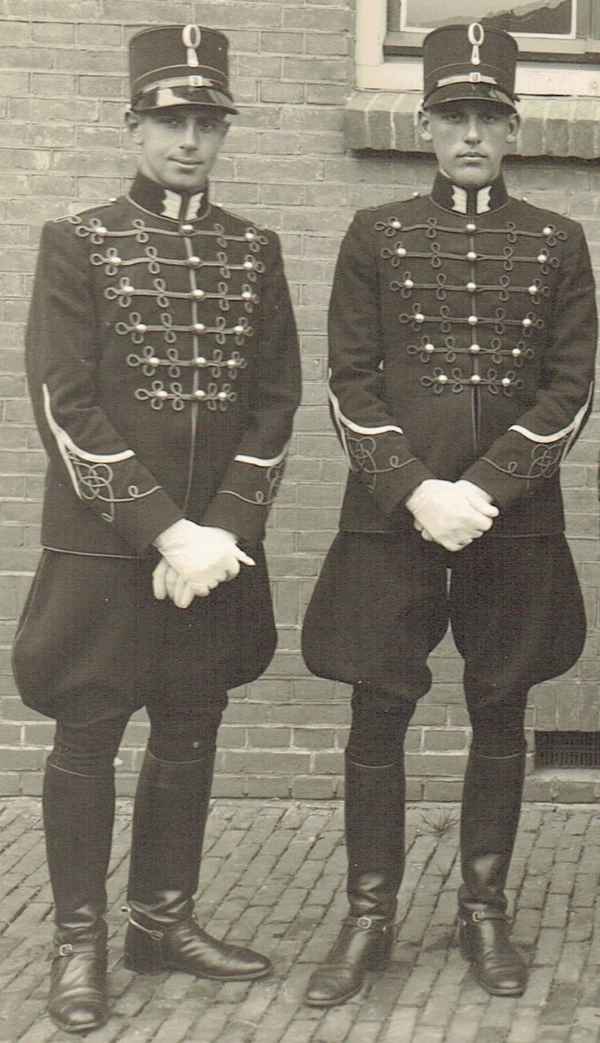
Maduro (left) and his good friend and co-draftee Oncko Wttewaal van Stoetwegen, both in the rank of sergeant in 1937. Photo Maduro family archive
After 46 weeks of terrible prison conditions, Maduro and Wttewaall were finally separated. It was late July 1944 when Wttewaall was taken to concentration camp Sachsenhausen while Maduro went to concentration camp Dachau in November 1944. At that point, Wttewaall weighed less than 123 lbs. Maduro was not much better off and had difficulty moving his legs; it turned out to be a type of oedema. He was also suffering from heart problems. On November 25th, 1944, Maduro arrived in Dachau after 11 terrible days of transport. Upon arrival, his legs were severely swollen, and he could no longer walk. From that moment on, in the eyes of the Nazi extermination machine, he was no longer George Maduro, but prisoner number 133401.[64]
In Dachau, Maduro met his cavalry friend Van Lanschot again, who, like him, had been arrested. After a long journey through various prisons, Van Lanschot had ended up in Dachau during the final year of the war. The reunion gave Maduro encouragement to continue, but his condition visibly declined.[65] In a personal letter from Van Lanschot to Maduro’s parents after the war, Van Lanschot noted how he was once again impressed by Maduro’s charisma in Dachau, despite his deteriorating physical condition. ‘His morale was still brilliant and cheerful. And about a week after arriving, he was already given the responsible task of dormitory leader. This was unique. He was immediately trusted, and his ‘honesty’ and ‘sincerity’ were never in doubt,’ Van Lanschot wrote.[66]
During the winter months in Dachau, the average temperature in the evenings and at night was around -10 degrees Celsius, and it often snowed. In such weather, the prisoners were often forced to stand at attention for hours during roll call, whilst wearing only scant clothing. Such conditions are already unbearable for a healthy person, let alone someone who was already severely weakened and in poor physical condition. On February 8th, 1945, Maduro died of typhus at the age of 28, completely worn out. Eleven weeks and three days before the liberation of the camp by units of the 7th US Army.[67]
Aftermath
It was not until July 1945 that Maduro’s parents learned that their only son had died in Dachau from illness and exhaustion. Maduro’s mother was heartbroken. During the war, Mrs Bep Boon-van der Starp, the wife of one of Maduro’s father’s business partners, sent a letter to Maduro’s mother after hearing about his imprisonment in the Oranjehotel. Maduro’s mother greatly appreciated this gesture and became friends with Mrs Boon.[68] After the war, Mrs Boon became involved with the Netherlands Student Sanatorium (NSS), a hospital in Laren where students with tuberculosis could recover and continue their studies. Because aftercare proved to be particularly expensive, she set out to find a revenue model for the sanatorium. She remembered seeing an original solution to a similar problem in Beaconsfield, England. A local accountant had built a large miniature railway in his garden, which attracted crowds of day trippers. The net proceeds went to the ailing hospitals in London.[69]
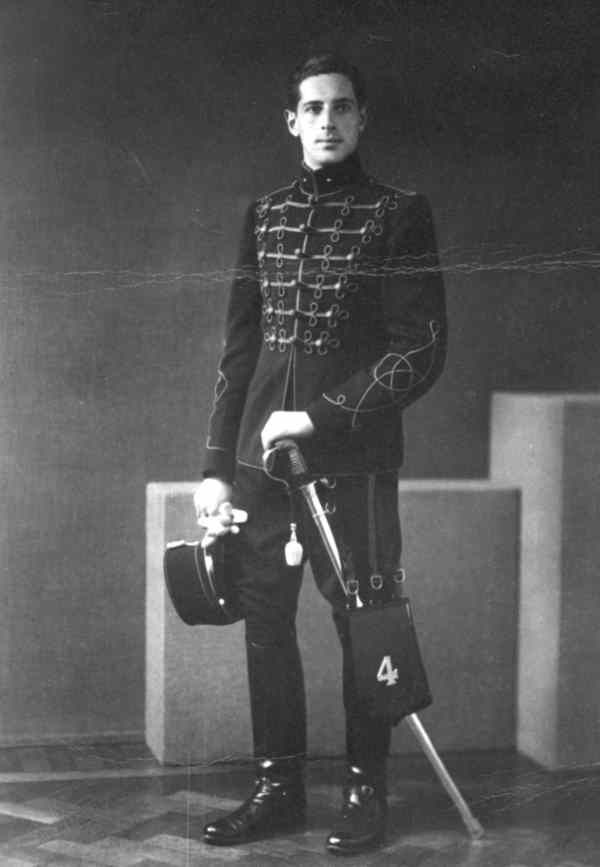
Maduro let slip a chance to flee from German prisonership and instead helped victims of an allied bombardment. His self-sacrifice can be a source of inspiration in the current times of uncertainty, conflicts and rising tensions. Photo The Hague Municipal Archive
In March 1950, Mrs Boon suggested at a board meeting of the NSS that this English revenue model be replicated in the Netherlands with the construction of a ‘miniature city’. [70] The initial capital for this project, 100,000 guilders, was donated by Maduro’s parents, who wanted to establish a memorial for their son. Over the years, Maduro’s parents had made several financial contributions to the maintenance and expansion of Madurodam.[71] Madurodam is a tribute to Second Lieutenant George Maduro and what many people are not aware of, is that Madurodam is one of the larger, if not the largest, war memorials in the Netherlands dedicated to one person.
In 1946, the Militaire Spectator reported that Lieutenant Maduro, along with several other Dutch military personnel[72] who had fought in May 1940 and had died during the Second World War, had been posthumously awarded the highest decoration for bravery by Royal Decree of 9 May 1946. In the case of Lieutenant Maduro, this was for his leadership and courageous actions during the attack on Villa Dorrepaal on 10 May 1940.[73] And that was quite remarkable for someone who had been promoted as an officer only six months earlier and who was initially told during officer training that he was too hesitant. He was also posthumously awarded the Verzetsherdenkingskruis (Resistance Memorial Cross) in the 1980s. This decoration is intended for participants in the resistance against the occupiers of Dutch territory during World War II.[74] Maduro also received this recognition.
This article memorialises George Maduro’s 80th anniversary as Knight of the Military Order of William. The three facets of Maduro’s identity, as a Jewish-Caribbean student in the Netherlands, as a cavalry officer and as a member of the Dutch resistance movement, provide more insight into the remarkable person he was to many. Maduro’s gift to inspire people is perhaps most impressively expressed by his cavalry friend Wttewaall. He wrote a letter to Maduro’s mother after learning that his friend had been awarded the Military Order of William: ‘Courage, Leadership and Loyalty, these are just three concepts. Loyalty is the easiest, then comes courage, but leadership, that’s what matters. Leadership beforehand is fine, everyone possesses some leadership afterwards, but leadership during the action, that’s what George had. […]. He cared deeply about his fellow men. His superiors and subordinates unanimously acknowledge this.’[75]Maduro made a big impression on people. And when his world descended into chaos, he showed his true character. He was someone who never gave up, and someone who, despite his own challenges, thought of others and helped them whenever and wherever he could. Let this be an inspiration in current times of uncertainty, rising tensions and conflicts.
[1] P.G.H. Maalderink (ed.), De Militaire Willems-Orde sedert 1940, Onder auspiciën van de Kanselier der Nederlandse Orden in samenwerking met de Sectie Militaire Geschiedenis van de Landmachtstaf (Rijswijk, Sijthoff Pers, 1982) 88.
[2] Gaby Hauck, Joods leven op Curaçao. Jossy Maduro, een micro-analyse van een Sefardisch-Curaçaose identiteit begin twintigste eeuw, master thesis (Rotterdam, Erasmus Universiteit, 2016) 44-51.
[3] Johan Hartog, Het verhaal der Maduro’s en Foto Album van Curaçao 1837-1962 (Aruba, Nederlandse Antillen, D.J. de Wit Uitgeverij, 1962) 107-123.
[4] Maduro Shipping, Maritime excellence, Trusted partner, Website, February 2026.
[5] Hauck, Joods leven op Curaçao, 48-49.
[6] Kathleen Brandt-Carey, Ridder zonder vrees of blaam. Het leven van George Maduro 1916-1945 (Houten, Uitgeverij Unieboek | Het Spectrum, 2016) 26-39.
[7] Sabine Onvlee, ‘In de tolerante Republiek werd weinig gemengd getrouwd’, Historisch Nieuwsblad, 27 mei 2003.
[8] Brandt-Carey, Ridder zonder vrees of blaam, 135-143.
[9] Ibidem, 38-41.
[10] Ben Braber, Omdat ik geen lam voor de wolven wil zijn. Joods verzet in Nederland in de Tweede Wereldoorlog (Amsterdam, Uitgeverij Balans, 2025) 32.
[11] Kathleen Brandt-Carey, ‘Tussen twee werelden’, Kathleen Brandt-Carey Website, 2017.
[12] He graduated from the Gymnasium-β course, a six-year secondary school programme that also includes Greek and Latin, and which qualifies one directly for university.
[13] The Leidsche Studenten Corps merged with the Vereeniging van Vrouwelijke Studenten te Leiden (Association of Female Students in Leiden) in 1973/1974 and continued under the name Leidse Studenten Vereniging Minerva (Leiden Student Association Minerva).
[14] Brandt-Carey, Ridder zonder vrees of blaam, 72-76.
[15] Kathleen Brandt-Carey, ‘Lezing voor Caribbean Book Club’, Kathleen Brandt-Carey Website, 2017; Stichting Informatie Wereldoorlog Twee (STIWOT), Traces of War: Maduro, George, John, Lionel.
[16] The Prins Willem III Barracks was demolished in 1978 and is now a residential area in Amersfoort. In the past, the barracks was often confused with the Koning Willem III Barracks in Apeldoorn
[17] Brandt-Carey, Ridder zonder vrees of blaam, 93-96.
[18] Sietske van der Veen, op cit in: Ruben Gishler, ‘De elite onder de loep’, Nieuw Israëlitisch Weekblad, 18 August 2004.
[19] Brandt-Carey, Ridder zonder vrees of blaam, 98.
[20] Just Koch himself was commander of the SROC from 1951 to 1953, eventually rising to the rank of brigadier general in the cavalry, and he was also the first chairman of the Militaire Ruitersport Vereniging ‘Te Paard’, Afdeling ’s-Gravenhage (Military Equestrian Association ‘Te Paard’, The Hague Branch).
[21] Arie Rens, De School Reserve Officieren Cavalerie. Terugblik op de periode 1918-1995 (Amersfoort, Vereniging Officieren Cavalerie, 1998) 16-19.
[22] Kathleen Brandt-Carey, ‘Ridder in de maak’, Kathleen Brandt-Carey Website, 2017.
[23] Kathleen Brandt-Carey, ‘Ridder in de maak. George Maduro’s opleiding aan de SROC 1936-1937’, Vereniging Officieren Cavalerie Mededelingen, 78 (2017) 3, 35-40.
[24] Departement van Defensie, Staat van Dienst, Maduro, George John Lionel, 2 December 1980. Documentation from the Library of the Historical Collection Cavalry (Historische Collectie Cavalerie/Nederlands Cavalerie Museum) Bernhard Barracks, Amersfoort.
[25] Brandt-Carey, ‘Ridder in de maak’, 40-41.
[26] Brandt-Carey, Ridder zonder vrees of blaam, 107-115.
[27] Departement van Defensie, Staat van Dienst, Maduro, George John Lionel.
[28] ‘De Looden Verrader’, Boegbeeld van de Koninklijke Marine, Website 2026.
[29] Brandt-Carey, Ridder zonder vrees of blaam, 132-135.
[30] Ibidem, 167-177.
[31] Ibidem, 177.
[32] Lou de Jong, Het Koninkrijk der Nederlanden in de Tweede Wereldoorlog, Deel 3, Mei ’40 (Den Haag, Martinus Nijhoff, 1970) 10-13.
[33] Nationaal Comité 4 en 5 mei, Den Haag, Bombardement Alexanderkazerne.
[34] Brandt-Carey, Ridder zonder vrees of blaam, 179-185.
[35] These were Fordson tractors with trailers for passenger transport, which had been introduced into the Dutch army in the 1930s to enable rapid deployment.
[36] Nederlands Instituut voor Militaire Historie (NIMH, Netherlands Institute of Military History) Collectie 409, Gevechtsverslagen en -rapporten, mei 1940, inventarisnummer 536023.
[37] The abbreviation ‘Pag’ stands for Panzer Abwehr Geschütz, an Austrian-designed anti-tank gun which served as the standard weapon system in the Dutch army in the days of May 1940.
[38] Dirk A. van Hilten, ‘De Infanterie te velde, De strijd tegen Duitse valschermjagers en luchtinfanteristen’, Militaire Spectator, 109 (1940) (7) 314-315.
[39] Van Hilten, ‘De Infanterie te velde’, 315-316.
[40] NIMH, Collectie 409.
[41] Eppo H. Brongers, De Slag om Ypenburg, (Rijswijk, Den Haag Media Groep, 2000) 91.
[42] Cees Schulten, ‘“Fall Festung”, de aanval op het regeringscentrum’, in: Herman Amersfoort and Piet Kamphuis (Ed), Mei 1940. De strijd op Nederlands grondgebied, 2e herziene druk (Den Haag, Sdu Uitgevers, 2005) 196-197.
[43] Nederlands Instituut voor Militaire Historie (NIMH, Netherlands Institute of Military History) Collectie 500, Militaire onderscheidingen, inventarisnummer 13 and 23.
[44] Brandt-Carey, Ridder zonder vrees of blaam, 190-194.
[45] A dumdum bullet is a bullet that fragments or expands upon impact with the human body. The name derives from a British Army munitions factory in the Indian town of Dum Dum near Calcutta, where the first such bullets were manufactured in 1898.
[46] George Maduro, Report to the Commander of the Cavalry Depot, concerning 13 May 1940, Appendix 2. A copy of the report is in the possession of the Historical Collection Cavalry, file ‘2nd Lieutenant G.J.L. Maduro'.
[47] Dieudonnée ten Berge, Bib van Lanschot. ‘Je bent pas verslagen als je het zelf opgeeft’ (Den Haag, BZZTôH, 1994) 41-42.
[48] Braber, Omdat ik geen lam voor de wolven wil zijn, 31-32.
[49] Brandt-Carey, Ridder zonder vrees of blaam, 209-212.
[50] ‘Uit den strijd rondom Den Haag: hoe een door den tegenstander bezette villa heroverd werd’ (From the Battle for The Hague: how a villa occupied by the enemy was recaptured) Haagse Courant, 3 August 1940.
[51] Brandt-Carey, Ridder zonder vrees of blaam, 209-212.
[52] Leiden Universiteit, ‘George Maduro: alumnus gered van vergetelheid’, Leiden University Website, 15 July 2016.
[53] Brandt-Carey, Ridder zonder vrees of blaam, 215-219.
[54] Haags Historisch Museum, ‘George Maduro – oorlogsheld en naamgever van Madurodam’, Haags Museum Website, 2026.
[55] Braber, Omdat ik geen lam voor de wolven wil zijn, 32-33.
[56] The Hon. Christine Wttewaall van Stoetwegen later became a member of parliament for the Christian Historical Union, a Christian party. She was known in Dutch politics as ‘de Freule’ (The Hon. Lady).
[57] Kathleen Brandt-Carey, Ridder zonder vrees of blaam, 231-240.
[58] Nationaal Monument Oranjehotel, ‘George Maduro, verzetsman van Curaçao’, Nationaal Monument Oranjehotel Website, 2026.
[59] Kathleen Brandt-Carey, ‘Veel gestelde vragen’, Kathleen Brandt-Carey Website, 2017. See: https://kathleenbrandtcarey.com/nl/kathleen-2/veelgestelde-vragen/.
[60] Brandt-Carey, Ridder zonder vrees of blaam, 255-260.
[61] National Kinderherdenking 4 mei, ‘Het verhaal van George Maduro’, National Kinderherdenking 4 mei Website, 2026.
[62] Brandt-Carey, Ridder zonder vrees of blaam, 307-340.
[63] Ibidem, 340-342.
[64] National Kinderherdenking 4 mei, ‘Het verhaal van George Maduro’.
[65] Brandt-Carey, Ridder zonder vrees of blaam, 354-372.
[66] Willem van Lanschot, A personal letter addressed to the parents of George Maduro after he received their address in New York, 9 January 1946. A copy of the letter is in the possession of the Historical Collection Cavalry, file ‘2nd Lieutenant G.J.L. Maduro’.
[67] Brandt-Carey, Ridder zonder vrees of blaam, 354-372.
[68] Kathleen Brandt-Carey, ‘Het Ontstaansverhaal van Madurodam’, Kathleen Brandt-Carey Website, 2017.
[69] Nationale Kinderherdenking 4 mei, ‘Het verhaal van George Maduro’.
[70] Ibidem.
[71] Stichting Joods Erfgoed Den Haag, George Maduro (1916-1945) en Madurodam.
[72] The soldiers concerned were Major W.P. Landzaat, Reserve Major J.N. Cramer, Captain I.H. Bolman, Reserve First Lieutenant (Pilot) A.H. Bodaan, Reserve First Lieutenant F.P. de Jager, Second Lieutenant C.E.F. Schnabel, Reserve Second Lieutenant (Observer) B. Swagerman, Sergeant W.J. Kenninck, Private B. Beekmans, Private G. Migchelbrink, and Private C.M. Oome; furthermore, by the same Royal Decree, the following were appointed as Knights of the Military Order of William, 4th class during lifetime: temporarily appointed Colonel W.F. Hennink, temporarily appointed Major G.J.W. Gelderman and conscripted Sergeant for Special Services J.F.C. Toelen.
[73] Redactie, ‘Officieele mededeelingen van het Ministerie van Oorlog, Herdenking van de gevallenen in mei 1940’, Militaire Spectator, 115 (1946) (3), 120-122.
[74] Nederlands Instituut voor Militaire Historie (NIMH) Collectie 500.
[75] Oncko Wttewaall van Stoetwegen, op. cit. in: Brandt-Carey, ‘Ridder in de maak’, Kathleen Brandt-Carey Website, 2017.